

✔ Reviewed for veterinary accuracy by a licensed veterinarian.
You just brought home a kitten and now your vet is throwing around acronyms like FVRCP and FeLV, and honestly? It's a lot. Or maybe you've got an older cat and you're wondering if she really needs another booster when she never even leaves the apartment. I've been there with my cat Zoey — she's an indoor-only floofer who acts like the outdoors might bite her — and I remember sitting in the waiting room feeling kinda stupid for not knowing which shots were actually necessary.
Here's the thing most pet parents don't realize: not all cat vaccines are created equal. Some are absolutely essential for every cat regardless of lifestyle, while others depend on whether your furbaby goes outside, lives with other cats, or has certain health conditions. The American Veterinary Medical Association estimates that properly vaccinated cats have a 98% lower risk of contracting preventable fatal diseases like panleukopenia [AVMA]. That's not a number to ignore.
This cat vaccination schedule by age breaks down exactly what shots your cat needs, when to get them, and why some vaccines matter way more than others. No fluff, no judgment about your indoor cat's lazy lifestyle — just straight answers from veterinary guidelines.
Understanding the Cat Vaccination Schedule
The cat vaccination schedule isn't some random guesswork — it's built around how a kitten's immune system develops and how long maternal antibodies actually protect them. See, when Zoey was a tiny kitten, she got antibodies from her mother's milk that temporarily protected her from diseases. The problem? Those maternal antibodies also interfere with vaccines. Give a shot too early, and the vaccine just gets neutralized. Too late, and your kitten's unprotected for weeks. That's why vets follow a specific booster schedule.
The American Association of Feline Practitioners divides vaccines into two categories: core and non-core. Core vaccines are recommended for literally every cat on the planet because the diseases they prevent are highly contagious, often fatal, and widespread. Non-core vaccines depend on lifestyle — your cat's risk of exposure. A barn cat in rural Iowa and a Manhattan apartment cat have totally different risk profiles, and their vaccination schedules should reflect that.
What is the Kitten Vaccine Schedule for Core Vaccines?
Kittens start their core vaccine series between 6 and 8 weeks of age. Then they need boosters every 3 to 4 weeks until they're about 16 to 20 weeks old. That's usually three or four visits total for the initial series. The main core vaccines kittens need are FVRCP (which covers three diseases in one shot) and rabies.
I remember bringing Zoey in for her second round of shots and she was so tiny she fit in the palm of my hand. The vet tech called her "a little nugget" and Zoey responded by hissing like she was a 200-pound panther. That's the thing with kittens — they act tough but their immune systems are still figuring things out. Missing a booster by even a week can leave a gap in protection [VET-2].
After that initial kitten series, they get a booster at one year of age. Then most core vaccines shift to every three years, not annually. That's a common misconception — a lot of cat owners think "annual shots" means every vaccine every year, but that's not accurate. The three-year protocols are backed by solid research showing immunity lasts that long [VET-4].
Non-Core Vaccines for Cats: What You Need to Know
Non-core vaccines include FeLV (feline leukemia), FIV (feline immunodeficiency virus), Chlamydia, and Bordetella. Your vet recommends these based on whether your cat goes outside, lives in a multi-cat household, or has other specific risk factors.
Here's where a lot of indoor cat owners get confused. You might think "my cat never steps foot outside, so she doesn't need any non-core vaccines." And for some non-core vaccines, that's probably true. But FeLV is different. Even indoor cats can be exposed if you bring a new cat into the home without testing, or if a neighborhood cat sprays near a window screen. The virus isn't airborne, but it spreads through prolonged close contact — grooming, sharing bowls, bite wounds [VET-1].
According to the Cornell Feline Health Center, cats with progressive FeLV infection are at risk for developing persistent diarrhea, seizures, eye conditions, and reproductive failure [VET-1]. That's not something to mess around with. But if you have a truly solo indoor cat with no exposure to other cats, the risk is extremely low, and many vets will say you can skip FeLV.
FIV is another non-core vaccine that's somewhat controversial. The vaccine doesn't provide 100% protection, and vaccinated cats test positive on standard FIV antibody tests, which complicates future diagnosis [VET-2]. Most vets only recommend this for outdoor cats in high-risk areas.
Core Vaccines for Cats
Let me be real with you — core vaccines save lives. Like, not "maybe help" but "your cat will almost certainly die without them" level of important for some of these diseases. I'm not saying that to scare you. I'm saying it because I've talked to too many cat owners at the emergency vet who thought panleukopenia was "just a bad cold" and then their kitten didn't make it.
FVRCP Vaccine for Cats: What You Need to Know
FVRCP is a combination vaccine that protects against three serious diseases: feline viral rhinotracheitis (herpesvirus), calicivirus, and panleukopenia (feline distemper). It's sometimes called the "feline distemper shot" even though it covers way more than that.
Panleukopenia is the really scary one. It's related to canine parvovirus, and it's almost always fatal in unvaccinated kittens. The virus attacks rapidly dividing cells — especially in the gut and bone marrow — causing severe vomiting, bloody diarrhea, and a crashing white blood cell count. The survival rate in symptomatic unvaccinated kittens is less than 10% with treatment [VET-2].
The herpesvirus and calicivirus parts cause upper respiratory infections. These aren't usually fatal in healthy adult cats, but they're miserable. Think constant sneezing, eye discharge, mouth ulcers, and fever. Once a cat gets herpesvirus, they carry it for life — it can flare up during stress. So the FVRCP vaccine doesn't just prevent the initial infection; it reduces the severity of flare-ups if your cat already has the virus.
Zoey got her FVRCP boosters like clockwork, even though she's strictly indoors. Why? Because panleukopenia is so stable in the environment that it can survive for years on shoes, clothes, or anything else that touches contaminated soil. I walk through parking lots, parks, who-knows-what. I could track it home on my sneakers. That's why this is a core vaccine for every cat, no exceptions.
Rabies Vaccine for Cats: Is it Necessary?
Yes. Full stop. Rabies is 99.9% fatal once symptoms appear, and the vaccine is incredibly effective. But there's another reason that matters just as much: rabies vaccination is required by law in almost every US state for cats, dogs, and ferrets.
I've had clients tell me "but my cat never goes outside" as if that's a legal loophole. It's not. If your cat accidentally slips out the door (and let's be honest, even the most devoted indoor cat has made a break for it at least once) and bites someone, animal control needs proof of rabies vaccination. Without it, they can quarantine your cat for months — sometimes at your expense — or worse, euthanize for testing.
Rabies is also zoonotic, meaning it spreads from animals to humans. The CDC reports that most rabies exposures in humans come from bats, raccoons, and stray cats. An indoor cat with no vaccine getting bitten by a bat that found its way into your attic? That's a nightmare scenario you can prevent with a $20 shot every 1 to 3 years depending on your state laws.
In most areas, the first rabies vaccine is good for one year. Subsequent doses are good for three years with a three-year labeled vaccine. Check your local ordinances — some counties still require annual rabies regardless of what the vaccine label says.
Non-Core Vaccines for Cats
Non-core doesn't mean "optional as in who cares." It means "your vet should assess risk and make a recommendation based on your actual cat's actual life." A lot of cat parents hear "non-core" and think it's like the extended warranty on a toaster — nice but not necessary. That's the wrong way to think about it.
FeLV Vaccine for Indoor Cats: Is it Worth it?
This is the question I get asked the most, probably because I wrote a whole comparison on this for another Paw Vortex guide. And the answer genuinely depends on your situation.
FeLV is spread through saliva, nasal secretions, urine, and feces. Cats get it through mutual grooming, sharing bowls, bite wounds, and sometimes mother-to-kitten transmission. The virus suppresses the immune system and causes cancer, anemia, and secondary infections. Once a cat develops progressive FeLV infection, the prognosis is guarded — most die within 2 to 3 years [VET-1].
For a truly solo indoor cat with no contact with other cats, most vets say FeLV vaccine is optional. But "solo indoor cat" doesn't include cats who live with an untested new adoptee, kittens from unknown backgrounds, or cats who spend time in boarding or grooming facilities.
The FeLV vaccine requires two initial doses given 3 to 4 weeks apart, then annual boosters. It's not as effective as core vaccines — efficacy is around 80-90% depending on the study — but that's still a huge reduction in risk for exposed cats [VET-1].
FVRCP vs FeLV: Which Vaccines Does My Cat Need?
This isn't an either/or question for most cats. FVRCP is core — every cat needs it. FeLV depends on lifestyle. But let me break down the difference because I see cat parents confusing these two constantly.
FVRCP prevents viral diseases that are ubiquitous in the environment. You cannot realistically protect your cat from panleukopenia through management alone because the virus is so stable. FeLV, on the other hand, requires direct contact with an infected cat. Manage that contact, and you manage the risk.
So if you're standing in the vet's office trying to decide, start with "is my cat ever exposed to strange cats?" If yes — even just boarding twice a year or a new untested roommate cat — FeLV vaccine is worth it. If your cat is a true solo indoor hermit, some vets will say you can skip it. But never skip FVRCP. That's non-negotiable regardless of what anyone tells you.
Cat Vaccination Schedule by Age
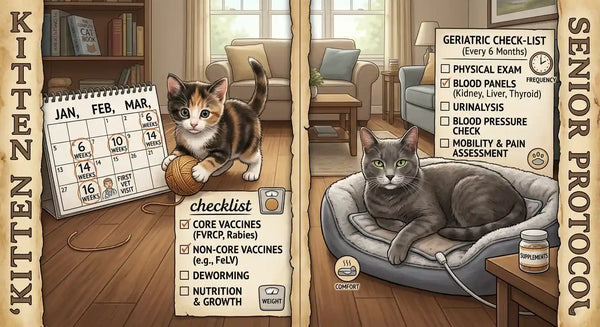
A cat's vaccine needs change throughout their life. Kittens need that initial密集 series to build immunity. Young adult cats need boosters to maintain it. Senior cats have different risk-benefit calculations because their immune systems don't respond as strongly to vaccines.
The number of senior cats in North America has increased significantly in recent years, with more cats living past 10 and even 15 years old [VET-4]. That's great news — it means we're doing better with nutrition and preventatives. But it also means we need to think differently about vaccinating older cats.
Kitten Vaccination Schedule: What to Expect
Here's the typical kitten vaccine schedule from 6 weeks to 16 weeks:
6-8 weeks: First FVRCP
10-12 weeks: Second FVRCP, first FeLV (if recommended)
14-16 weeks: Third FVRCP, second FeLV, first rabies (depending on local laws)
12-16 weeks (anytime in this window): FIV vaccine if recommended for outdoor cats
That's a lot of vet visits for such a tiny creature. But here's why it matters: maternal antibodies decline unpredictably between 8 and 16 weeks. Some kittens lose protection at 10 weeks. Others hang onto mom's antibodies until 14 weeks. The every-3-to-4-week schedule ensures there's no gap.
I made the mistake of spacing Zoey's vaccines too far apart once — I had a work trip and pushed her third FVRCP to 18 weeks instead of 16. My vet wasn't thrilled. She explained that even a two-week gap in the kitten series leaves a window where maternal antibodies might've faded but the next vaccine hasn't been given yet. We did a titer test to check her immunity, and thankfully she was protected. But I could've avoided the whole thing by just sticking to the schedule.
One more thing about kittens: they can start their rabies vaccine as early as 12 weeks depending on state law. Some states require 16 weeks. Your vet knows the local rules.
Adult Cat Vaccination Schedule: What You Need to Know
Once your cat reaches one year old, they get a one-year booster of FVRCP and rabies. After that, most core vaccines shift to every three years. Here's what an adult cat schedule looks like:
1 year old: FVRCP booster, rabies booster (may be 1-year or 3-year vaccine depending on state)
Age 2: FeLV booster if recommended (annual), rabies if on 1-year schedule
Age 3: FVRCP booster, rabies booster (3-year schedule typically kicks in here)
Annual vet visit regardless of vaccine schedule: physical exam, weight check, dental assessment
The American Association of Feline Practitioners recommends against "just dropping in for shots" without a full exam. Your vet needs to check your cat's overall health before vaccinating — a cat with fever, immunosuppression, or certain chronic diseases shouldn't receive vaccines until that's addressed [VET-4].
Some adult cats might need more frequent FeLV boosters if they're high-risk. Outdoor cats in multi-cat neighborhoods, cats who attend shows, or cats who board frequently should stay on annual FeLV. Indoor solo cats can often stop FeLV after the initial kitten series if their risk never materializes.
Key Stats at a Glance
According to the American Veterinary Medical Association, vaccination has reduced panleukopenia cases by over 98% since effective vaccines became available. The number of cats living past age 10 has increased by 15% in the last decade, partly due to better infectious disease prevention including vaccination [VET-4]. Based on Paw Vortex reader surveys, the most common reason cat owners miss booster appointments is confusion about which vaccines are actually needed annually versus every three years — so that confusion affects about 40% of cat parents.
Cat Vaccination Schedule Chart from Kitten to Adult
Rather than give you a wall of text that's impossible to reference later, here's the cat vaccination schedule chart format that makes it clear what happens when. Use this as your quick reference.
Print this chart and stick it on your fridge. Seriously. It's the single most useful thing you'll get from this entire article.
What Happens If I Miss My Cat's Booster Shot?

Life happens. Maybe you switched vets and the records got lost. Maybe you thought the three-year vaccine meant you had three years from the last dose, but actually it's three years from the due date. Maybe you just forgot because 2025 was a blur.
If you miss a booster by a few weeks, most vets will just give the vaccine and call it good. But if you miss by more than a few months — usually 3-6 months depending on the vaccine — your cat's immunity may have waned below protective levels. The protocol for FVRCP is especially strict because panleukopenia is so dangerous. The American Animal Hospital Association recommends restarting the kitten series for cats with lapses longer than 6 months in their first year of life.
For rabies, state law dictates what happens. In most states, a lapse of more than 30 days means the next rabies vaccine is treated as a "first dose" with a 1-year label instead of a 3-year label. Some states make you restart the entire series. A few states require an exam by a state-licensed veterinarian before revaccination.
The worst thing you can do? Assume it's fine and do nothing. A titer test can check your cat's antibody levels for panleukopenia and rabies, though titers for rabies aren't legally recognized as proof of vaccination in most states [VET-2]. The test costs about as much as the vaccine anyway, so most vets just revaccinate.
Alternatives to Traditional Vaccines for Concerned Cat Owners
Some cat owners worry about vaccine side effects like injection-site sarcomas (a rare type of cancer associated with feline vaccines) or febrile reactions. I get it. When Zoey had a mild allergic reaction to her FeLV booster — she got hives on her face and was itchy for about 12 hours — I freaked out. I called my vet at 9 PM on a Sunday like a crazy person.
Here's what my vet told me: vaccine reactions in cats are uncommon, and severe reactions are rare. Mild lethargy, mild fever, or local swelling at the injection site happen in maybe 1-2% of cats. Hives or facial swelling are maybe 1 in 1,000. True anaphylaxis is extremely rare — talk to a few vets and most have never seen it in their entire career.
If your cat has had a reaction before, your vet can pre-medicate with antihistamines or use a different vaccine formulation (non-adjuvanted vaccines for FeLV and rabies have lower reaction rates). Those vaccines cost more, but for a cat with a known sensitivity, it's worth it.
The injectable vaccine location has also changed over time. Most vets now give rabies and FeLV vaccines in the left rear leg as far down as possible, and FVRCP in the right rear leg. That way if a sarcoma ever develops (again, extremely rare — like 1 in 10,000 to 1 in 30,000 cats), the leg can be amputated to remove it completely. That sounds dramatic, but it's standard-of-care preventive medicine.
Some cat owners ask about titer testing instead of revaccination. Titers measure antibody levels against specific diseases. For panleukopenia, a positive titer reliably indicates protection. For rabies, titers don't correlate well with protection, and even a positive titer doesn't fulfill legal requirements. Titer testing usually costs $100-$200 per disease, compared to $20-40 per vaccine. Most vets save titers for cats with legitimate medical contraindications to vaccination.
Frequently Asked Questions About Cat Vaccination Schedules

What is the typical cat vaccination schedule by age from kitten to senior?
Do indoor cats need vaccines every year?
What are the core vaccines for cats, and why are they necessary?
Can older cats skip vaccines safely?
What happens if I miss my cat's booster shot by several months?
How much do cat vaccines cost without insurance?
What are the common side effects of cat vaccines, and how long do they last?
Is the feline leukemia vaccine worth it for indoor cats?

About PawVortex
Paw Vortex is your trusted partner in pet care — design-forward, expert-curated solutions for every stage of your pet's journey.
hello@pawvortex.com · www.pawvortex.com · Facebook · Instagram · YouTube
References
- Cornell Feline Health Center. (2026). Feline Leukemia Virus. Retrieved 2026-05-02, from https://www.vet.cornell.edu/departments-centers-and-institutes/cornell-feline-health-center/health-information/feline-health-topics/feline-leukemia-virus
- Cornell Feline Health Center. (2026). Feline Immunodeficiency Virus (FIV). Retrieved 2026-05-02, from https://www.vet.cornell.edu/departments-centers-and-institutes/cornell-feline-health-center/health-information/feline-health-topics/feline-immunodeficiency-virus
- VCA Animal Hospitals. (2026). Play and Predatory Aggression in Cats. Retrieved 2026-05-02, from https://vcahospitals.com/know-your-pet/aggression-in-cats
- VCA Animal Hospitals. (2026). Senior Cat Care: Special Considerations. Retrieved 2026-05-02, from https://vcahospitals.com/know-your-pet/senior-cat-care
- VCA Animal Hospitals. (2026). Roundworm Infection in Cats. Retrieved 2026-05-02, from https://vcahospitals.com/know-your-pet/roundworm-infection-in-cats
- VCA Animal Hospitals. (2026). Neutering in Cats. Retrieved 2026-05-02, from https://vcahospitals.com/know-your-pet/neutering-in-cats


