

✔ Reviewed for veterinary accuracy by a licensed veterinarian.
Introduction to Spay and Neuter Procedures
Understanding Spay Neuter Benefits Risks for Pet Owners
Spaying and neutering are surgical sterilization procedures performed by veterinarians. Spaying (technically called an ovariohysterectomy) removes the ovaries and uterus in female pets. Neutering (castration or orchidectomy) removes both testicles in males. According to VCA Hospitals, these procedures prevent reproduction and come with significant health and behavioral benefits. The decision of when to neuter a dog or spay a cat is not one-size-fits-all. What surprised me when I dug into the research is how much the recommendations have shifted in just the past five years, especially for large breed dogs. Most owners I have spoken with notice changes in marking, roaming, and heat-related behaviors before they notice anything else, and those are often the first signs that it is time to have the conversation with your vet.
Spay Neuter Age Recommendation 2026 for Dogs and Cats
The spay neuter age recommendation 2026 looks different than it did a decade ago. For small breed dogs (under 50 pounds adult weight), most veterinarians still recommend spaying or neutering around six months of age. For large breed dogs (over 50 pounds), many now recommend waiting until growth plates close — typically 12 to 15 months for females and 18 to 24 months for males. For giant breeds like Great Danes, some vets push neutering as late as 24 months. Cats are a different story. The best age to spay a female cat is generally five to six months, before her first heat cycle. Male cats should be neutered around the same time to prevent spraying and roaming behaviors.
One of the clearest findings from recent veterinary research is that early spay risks dogs in certain ways we did not fully understand before. Removing sex hormones before skeletal maturity appears to increase the risk of cranial cruciate ligament tears and certain joint disorders, particularly in larger breeds. That said, waiting too long has its own trade-offs, including the risk of unwanted pregnancy and, in females, mammary cancer and pyometra (a life-threatening uterine infection).
Key Finding: The Timing Trade-Off
A 2020 study of over 1,500 Golden Retrievers found that dogs spayed or neutered before one year of age had significantly higher rates of hip dysplasia and cruciate ligament tears compared to those sterilized later. However, the same study showed that intact females faced a 50 percent or higher risk of mammary cancer if allowed to go through multiple heat cycles. There is no perfect age — only trade-offs you should discuss with your veterinarian.
Benefits of Spaying or Neutering Your Pet
Benefits of Spaying a Cat to Prevent Spraying Behavior
The benefits of spaying a cat extend far beyond preventing unwanted litters. According to VCA Animal Hospitals, spaying eliminates the risk of pyometra (a serious uterine infection that can be fatal) and greatly reduces the risk of mammary cancer, especially when done before the first heat cycle. But the question most cat owners really want answered is does spaying a cat stop spraying behavior completely? The honest answer is: for most cats, yes. When a female cat is in heat, she may spray urine to signal her availability to males. Spaying removes the hormonal drive behind that behavior. Studies show that approximately 90 percent of female cats stop spraying entirely after spaying. However, if spraying has become a learned habit or is driven by stress rather than hormones, spaying alone may not solve it completely.
Neuter Behavioral Changes Dogs Experience After Surgery
Neuter behavioral changes dogs experience fall into two categories: hormone-driven behaviors and everything else. The behaviors that typically decrease after neutering include roaming (looking for females in heat), mounting, and marking territory with urine. But the big question many owners ask is does neutering calm down a hyper dog science says — and the science says it is complicated. Neutering reduces testosterone, which can lower aggression driven by mating competition. It does not, however, turn a high-energy working breed into a couch potato. Hyperactivity is usually a training and exercise issue, not a hormone issue. What neutering will not fix: fear-based aggression, separation anxiety, obsessive-compulsive behaviors, or lack of impulse control. Those require behavioral modification.
⚠ Important
If your primary reason for neutering is to solve a behavioral problem you are already struggling with, have a conversation with your vet first. Some behaviors will improve. Some will not. And some may actually worsen if the underlying cause is fear or anxiety rather than testosterone.
Risks and Complications of Spaying or Neutering
Risks of Spaying Dog Too Early What Vets Now Recommend
The risks of spaying dog too early what vets now recommend centers on orthopedic health and certain cancers. Removing a female puppy's ovaries before she reaches skeletal maturity deprives her of estrogen, which plays a role in closing growth plates. The result can be slightly longer bones and altered joint angles, which may increase the risk of hip dysplasia and cruciate ligament tears. Some studies have also found an increased risk of certain cancers — specifically hemangiosarcoma and osteosarcoma — in dogs spayed or neutered early. That said, the AVMA does not recommend abandoning early spay/neuter entirely. Instead, the current approach is to individualize timing based on breed, projected adult size, and lifestyle. For a small mixed-breed dog, the risks of waiting may outweigh the benefits. For a male Great Dane, waiting until 18 to 24 months is now standard.
Spay vs Neuter Which is Harder on the Pet

The question of spay vs neuter which is harder on the pet has a clear answer: spaying is the more invasive surgery. A neuter (castration) is a relatively quick procedure. The veterinarian makes a small incision near the scrotum, removes the testicles, and ties off the spermatic cord. The entire procedure often takes ten to twenty minutes. A spay, by contrast, is an abdominal surgery. The veterinarian makes an incision through the abdominal wall, locates the ovaries and uterus, ties off blood vessels, and removes the organs. That is a bigger deal. Recovery from a spay takes longer and carries higher risks of complications like infection or internal bleeding. However, that does not mean neutering is risk-free. Complications are rare in both procedures when performed by a licensed veterinarian, but the surgical intensity is not the same.
Cost of Spaying or Neutering Your Pet
Cost of Spaying a Dog and How to Find Low Cost Options
The cost of spaying a dog ranges widely depending on where you live, the size and age of your dog, and whether you go to a full-service vet or a low-cost clinic. Expect to pay anywhere from $200 to $800 for a spay at a private veterinary practice. Neutering is generally cheaper — $150 to $500. These prices typically include anesthesia, surgery, pain medication, and often a follow-up visit. If you are asking low cost spay neuter programs usa how to find, the answer is easier than you might think. Most major cities have at least one nonprofit or municipal program offering subsidized sterilization. Start by searching "low cost spay neuter near me" or checking the ASPCA's national database of low-cost programs. Humane societies and animal control shelters often run monthly clinics. Some programs offer vouchers that cover most or all of the cost for qualifying low-income households. Do not let cost be the reason you skip this procedure — help is available in almost every state.
Spay and Neuter Recovery Timeline

How Long Spay Recovery Takes Week by Week for Dogs and Cats
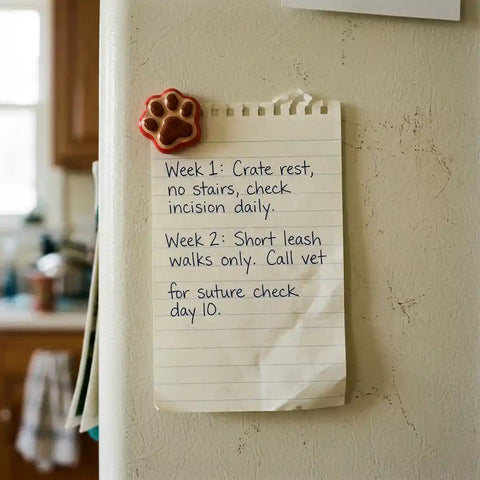
How long spay recovery takes week by week is one of the most common questions owners ask because watching your pet wear a cone and struggle to get comfortable is genuinely stressful. Here is the honest timeline.
Days 1 to 3: The Hardest Part
Your pet will be groggy from anesthesia and pain medication. Keep them confined to a small area — a crate or a single room. No jumping, no stairs, no running. Offer small amounts of water and food. Most pets sleep 18 to 20 hours a day during this window.
Days 4 to 7: Starting to Feel Better (Which Is Dangerous)
Your dog or cat will want to return to normal activity. Do not let them. This is the period when incisions reopen or sutures pull out. Continue restricted activity. The incision should look clean and dry. Any redness, swelling, or discharge means call your vet.
Days 8 to 14: Suture Removal and Gradual Return
Most vets remove external sutures or check internal absorbable sutures around day 10 to 14. After clearance, you can slowly increase activity over another week. No off-leash running or rough play for a full 14 days after surgery.
For neuters, the timeline is shorter — most male dogs and cats are back to near-normal within 7 to 10 days. The key difference is that neuters do not involve an abdominal incision, so there is less internal healing required. But the external activity restrictions still matter. A jumping male dog can still tear his scrotal incision open.
Conclusion and Final Thoughts
Is it Too Late to Neuter a 5 Year Old Dog and What to Expect
The short answer is no — is it too late to neuter a 5 year old dog? Absolutely not. Adult dogs are neutered all the time, and the procedure is safe for healthy adults of any age. However, what to expect is different from neutering a puppy. A five-year-old dog has already developed lifelong habits. Neutering will stop testosterone-driven behaviors like roaming and marking that are currently happening, but it will not erase years of learned behavior. If your dog has been marking furniture for three years, he may continue marking out of habit even after the hormone source is gone. The health benefits still apply — neutering eliminates the risk of testicular cancer and reduces the risk of prostate issues. But the behavioral changes will be less dramatic than if you had neutered him at six months. Talk to your vet about a pre-surgical blood work panel to ensure his liver and kidneys can handle anesthesia. In most cases, a healthy five-year-old dog sails through neutering with no more difficulty than a puppy.

About Paw Vortex
Paw Vortex publishes evidence-based pet care guides for US pet owners. Our team researches every article using current veterinary literature and expert consultation. We also stock premium pet supplies — free shipping on US orders over $35.
hello@pawvortex.com · www.pawvortex.com · Facebook · Instagram
Frequently Asked Questions About Spaying and Neutering
What is the best age to spay a female dog by breed size?
Does neutering calm down a hyper dog science says?
What are the risks of spaying a dog too early what vets now recommend?
How long does spay recovery take week by week?
Is it too late to neuter a 5 year old dog?
What are the benefits of spaying a cat?
What are the costs of spaying or neutering a pet?
How can I find low cost spay neuter programs in the USA?
References
- VCA Hospitals. "Neutering in Dogs". Retrieved 2026-04-28. https://vcahospitals.com/know-your-pet/neutering-in-dogs
- VCA Hospitals. "Spaying in Dogs". Retrieved 2026-04-28. https://vcahospitals.com/know-your-pet/spaying-in-dogs
- VCA Animal Hospitals. (2026). Spaying in Cats. Retrieved 2026-05-02, from https://vcahospitals.com/know-your-pet/spaying-in-cats
- VCA Animal Hospitals. (2026). Neutering in Cats. Retrieved 2026-05-02, from https://vcahospitals.com/know-your-pet/neutering-in-cats
- AVMA. Spaying and Neutering. Retrieved 2026-05-23, from https://www.avma.org/resources/pet-owners/petcare/spaying-and-neutering


