

The Silent Sufferer: Why AI is a Cat Parent's New Best Friend
Cats are masters of disguise, especially when it comes to pain. In the wild, showing weakness is dangerous. This instinct means that by the time your cat obviously limps, stops eating, or cries out, their condition—be it osteoarthritis, dental disease, or kidney issues—may be significantly advanced. For decades, cat parents and veterinarians have had to play detective, relying on subtle, often-missed behavioral shifts.
Enter the 2026 shift in pet care technology: the rise of the Diagnostic Companion. We're moving beyond simple pet cameras that let you watch your cat sleep. Today's AI cat behavior analysis tools use computer vision and predictive algorithms to quantify the invisible. They track micro-changes in facial expression (using the validated Feline Grimace Scale), posture, gait, litter box habits, and activity patterns to generate actionable health data.
This guide will demystify how AI-driven feline health monitoring works, what specific signs it detects, and how you can use this technology to become a more proactive advocate for your cat's well-being. The goal is no longer just observation; it's early intervention and peace of mind.
Table of Contents
- Why Cats Hide Pain: The Survival Instinct Problem
- The Feline Grimace Scale & AI: Automating the "Pain Face"
- AI Pet Monitor Features to Look For in 2026
- Beyond the Face: Key Behavioral Data Points AI Tracks
- Spotting Specific Conditions: From Arthritis to Kidney Disease
- The Multi-Cat Household: How AI Handles Identification
- From Data to Diagnosis: Integrating with Your Veterinarian
- Limitations & Ethical Considerations of AI Monitoring
- Statistics: The Hidden Reality of Feline Pain
- 5 Practical Solutions for Proactive Cat Health Monitoring
- Supportive Products for Comfort & Observation
- Final Thoughts & Key Takeaways
- FAQ: AI Cat Pain Detection
Why Cats Hide Pain: The Survival Instinct Problem
Understanding why cats are stoic is the first step to appreciating why technology is necessary. This behavior, known as "masking," is a deeply ingrained survival tactic. In a predator-prey dynamic, an animal that appears vulnerable becomes a target.
The Consequences of Masking
This instinct has dire consequences in a domestic setting. A study in the Journal of Feline Medicine and Surgery suggests that a significant percentage of cats with painful conditions like degenerative joint disease show no obvious lameness to their owners. The signs are subtle behavioral changes that are easy to attribute to "slowing down" or "just getting old."
Commonly Missed Early Signs
- Reduced Jumping: Not failing to jump, but taking shorter jumps, hesitating, or using furniture as "steps."
- Decreased Grooming: A dull coat, matting, or overgrooming a specific painful area.
- Litter Box Aversion: Painful arthritis can make it hard to step into a high-sided box; urinary pain can create negative associations.
- Subtle Facial Tension: Squinted eyes, flattened ears, and a tightened muzzle—the basis of the Feline Grimace Scale.
- Change in Social Dynamics: Hiding more, avoiding petting (especially in painful areas), or becoming unusually clingy.
Human observation alone, especially amidst busy schedules, is often inadequate to catch these digital biomarkers for cat health. This is where continuous, objective AI-driven litter box habit analysis and movement tracking fills a critical gap.
The Feline Grimace Scale & AI: Automating the "Pain Face"
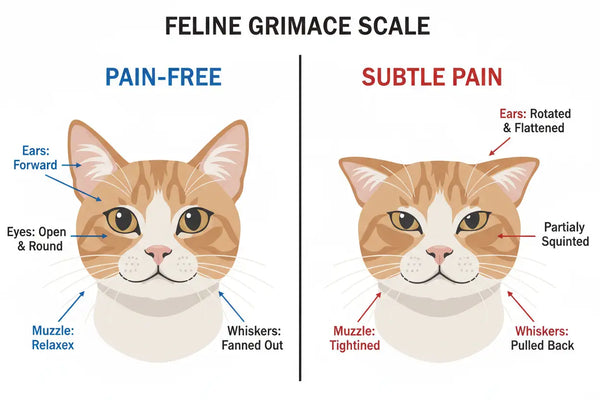
The Feline Grimace Scale (FGS) is a clinically validated tool used by veterinarians to assess acute pain by scoring five facial action units: ear position, orbital tightening, muzzle tension, whisker position, and head position. Until recently, applying this required trained eyes.
AI automation of the FGS is a breakthrough. Computer vision for pet pain assessment works by:
- Facial Landmarking: The AI map key points on the cat's face (ears, eyes, muzzle, whiskers).
- Real-time Analysis: It analyzes live or recorded video feed, measuring changes in the distance and angle between these landmarks.
- Scoring & Alerting: The system assigns a pain score based on deviations from the cat's established "neutral" baseline and can send an alert to your phone.
What AI "Sees" That You Might Miss
| Facial Feature | Pain-Free / Relaxed | Painful / Tense (What AI Detects) |
|---|---|---|
| Ears | Forward and relaxed | Slightly rotated outward, flattened, or asymmetrical |
| Eyes | Open, rounded | Squinted, partially closed, orbital tightening |
| Muzzle & Whiskers | Relaxed, whiskers fanned and loose | Tightened, narrowed, whiskers pulled back or straight |
| Head Position | Held above the shoulders | Held below the shoulders, tucked |
This automated facial landmarking for cats provides an objective, consistent measure, free from the variability of human perception or the fact that your cat might "pose" differently when you're actively watching.
AI Pet Monitor Features to Look For in 2026
Not all "smart" pet cameras are created equal. As you evaluate smart pet camera health alerts and monitoring systems, look for these specific features that define a true Diagnostic Companion.

Core AI Detection Capabilities
- Facial Expression Analysis (FGS-based): The cornerstone feature. Ensure the company specifies it uses a validated model based on veterinary science.
- Posture & Gait Analysis: Can it detect limping, stiffness, or changes in how your cat walks and sits? Real-time cat posture monitoring is key for musculoskeletal issues.
- Activity Level Benchmarking: Establishes a baseline for your cat's normal play, rest, and sleep cycles, flagging significant decreases or increases.
- Litter Box Usage Metrics: Tracks frequency, duration, and outcomes (if applicable). AI-driven litter box habit analysis is crucial for early signs of FLUTD or kidney issues.
Technical & Usability Features
- Multi-Cat Identification: Essential for households with more than one cat. The system should distinguish between cats to attribute data correctly. Look for multi-cat identification AI cameras.
- High-Resolution Night Vision: Many subtle behaviors occur at night. Clear, detailed footage is non-negotiable.
- Customizable Alert Thresholds: You should be able to adjust sensitivity. Is an alert triggered by a single event or a sustained pattern?
- Vet-Shareable Reports: The system should compile data into clear, graphical reports (PDF, etc.) you can email to your veterinarian for a home-based veterinary triage consultation.
- Privacy & Data Security: Understand where video and data are stored (cloud/local), who has access, and your options for data deletion.
When researching, ask: Does this device simply show me my cat, or does it analyze and inform me about my cat's well-being? The latter is the predictive feline health monitoring standard for 2026.
Beyond the Face: Key Behavioral Data Points AI Tracks
While the face is a primary pain indicator, AI cat behavior analysis synthesizes data from multiple streams to build a comprehensive health picture. These digital biomarkers for cat health create a baseline of "normal" for your individual cat, making deviations statistically significant and alert-worthy.
Activity & Mobility Metrics
- Jump Height & Success Rate: AI can measure the peak height of jumps onto furniture. A gradual decline is a major red flag for subtle signs of feline osteoarthritis.
- Gait (Walking) Analysis: It assesses symmetry in stride, weight distribution, and stiffness. A slight head bob or hip sway can be quantified.
- Resting Posture: Does your cat always curl up but now lies in a "loaf" position with legs tucked? AI notes these positional shifts over time.
- Overall Activity Score: A composite score of active minutes, play intensity, and distance traveled within the home.
For environmental enrichment that encourages gentle movement for tracking, consider an Automatic Laser Cat Toy or an Automatic Cat Teaser Turntable Toy to stimulate activity during the day.
Elimination & Consumption Patterns
- Litter Box Visits: Frequency, duration, and time of day. Increased trips can signal cystitis or kidney disease; straining can signal blockage.
- Water Bowl Visits: Increased drinking is a classic sign of kidney issues and diabetes. AI paired with a smart water bowl can track this.
- Food Consumption: Smart feeders paired with AI can note if your cat approaches but doesn't eat (a sign of nausea or dental pain).
Quick-Reference: Is It Pain or Just Quirky Behavior?
| Behavior | Possible Quirk/Boredom | Possible Pain/Medical Issue (AI Detects Pattern) |
|---|---|---|
| Not Using Litter Box | Dirty box, dislike of litter type | FLUTD, arthritis (can't step in), kidney disease (urgency) |
| Decreased Grooming | Old age, laziness | Osteoarthritis (can't twist), dental pain, obesity, systemic illness |
| Sleeping in New Locations | Exploring new cozy spots | Seeking warmth (arthritis), hiding (general malaise), avoiding painful jumps to favorite perch |
| Pacing or Nighttime Vocalization | Boredom, "zoomies", attention-seeking | Early signs of feline cognitive dysfunction, hypertension, hyperthyroidism (AI tracks increased restlessness) |
Spotting Specific Conditions: From Arthritis to Kidney Disease
The power of predictive feline health monitoring is its ability to connect seemingly minor behavioral shifts to specific health conditions long before a crisis.
1. Degenerative Joint Disease (Arthritis)
Affecting over 90% of cats over age 12, arthritis is the prime target for AI detection. AI Data Points:
- Mobility: Declining jump height/success, slower gait speed, stiffness after rest.
- Posture: Hunched back, low head carriage.
- Activity: Reduced overall activity, longer rest periods.
- Grooming: Reduced grooming, especially on the back and hindquarters.
Actionable Insight: An AI alert on declining mobility can prompt a vet visit, leading to pain management (supplements, medication), environmental modifications (ramps, lower litter boxes), and supportive bedding like a Cozy Corner Pet Bed for easy access.
2. Feline Lower Urinary Tract Disease (FLUTD) & Kidney Disease
AI Data Points:
- Litter Box: Increased frequency, longer duration in box, multiple visits in short succession (AI-driven litter box habit analysis).
- Water Consumption: Marked increase in trips to the water bowl (polydipsia).
- Facial Expression: Grimacing or signs of discomfort during/post-elimination.
Actionable Insight: Early detection of FLUTD can prevent a deadly urinary obstruction. Data showing increased water intake is a direct flag for kidney function tests. Maintaining a clean environment with a Cat Odor Purifier encourages litter box use.
3. Dental Disease & Oral Pain
Affects most cats by age 3. AI Data Points:
- Eating Behavior: Approaching food then leaving, chewing on one side, dropping food.
- Facial Expression: Consistent muzzle tension, lip licking, pawing at mouth.
- Grooming: Stopping grooming due to facial tenderness.
Actionable Insight: AI can't diagnose a tooth root abscess, but it can provide strong evidence of oral discomfort, prompting a dental exam.
The Multi-Cat Household: How AI Handles Identification
For homes with multiple cats, the challenge doubles: not only do you need to detect problems, but you also need to know which cat has the problem. This is where advanced multi-cat identification AI cameras become essential.
How AI Distinguishes Between Cats
Modern systems use a combination of techniques:
- Visual Recognition (Computer Vision): The AI learns unique visual markers—coat color/pattern, size, shape, facial structure—to create a "fingerprint" for each cat. This is the most common method.
- RFID or Bluetooth Collar Tags: Some advanced systems pair with lightweight tags on breakaway collars for 100% accurate identification, especially useful for identical-looking cats.
- Behavioral "Gait Print": Analyzing individual walking styles and movement patterns as a secondary identifier.
Setting Up for Success
- Clear Initial Training: During setup, you'll be asked to name each cat and likely tag them in several videos to train the AI model.
- Strategic Camera Placement: Place cameras in areas where cats are likely to be alone (individual feeding stations, separate litter boxes, favorite sleeping nooks like a Warm Triangle Yurt Bed) to capture clean data.
- Monitor Resource Access: AI can alert you if one cat is blocking another from food, water, or the litter box—a common source of stress and hidden health issues.
Data Summary: The Value of Individual Tracking
| Scenario Without ID | Scenario With Multi-Cat AI ID | Health Outcome |
|---|---|---|
| AI detects "a cat" is vomiting more frequently. | AI alerts you that "Mittens has vomited 3 times this week," with timestamps and video clips. | You can seek targeted care for Mittens immediately, rather than worrying about both cats or missing the pattern. |
| Litter box usage spikes, but you have 3 cats. | Report shows "Shadow is visiting the litter box 15x/day, up from his normal 5x." | Early, specific evidence of a potential urinary tract issue for Shadow. |
| One cat is losing weight, but they all eat together. | AI + smart feeder data shows "Leo is consuming only 50% of his daily kcal." | Direct evidence of inappetence, prompting investigation into causes like dental pain or illness. |
This level of specificity transforms data from interesting to critically actionable, making remote feline behavior tracking in multi-cat homes not just possible, but powerfully effective.
From Data to Diagnosis: Integrating with Your Veterinarian

The most sophisticated AI cat behavior analysis is only as good as the action it prompts. The goal is not to replace your veterinarian, but to empower you with concrete evidence for a more productive partnership—a true home-based veterinary triage tool.
How to Present AI Data to Your Vet
Veterinarians appreciate objective data. Walking in with a report is far more effective than saying, "She seems off."
- Compile the Report: Use your AI monitor's export function to create a PDF summary for the relevant time period (e.g., "Last 30-Day Behavior Trends for Whiskers").
- Highlight Key Alerts: Note the specific alerts you received (e.g., "12 Grimace Scale alerts on 5 separate days," "Jump height declined 40% over 3 months").
- Include Video Clips: Most systems let you save short video snippets linked to alerts. A 15-second clip of your cat hesitating before a jump is powerful evidence.
- Frame it as Collaboration: "My AI monitor flagged these changes in Whiskers' behavior. I wanted to bring this data to you for your professional interpretation."
What Your Vet Can Do With This Data
- Targeted Physical Exam: Instead of a general check-up, they can focus on specific areas—palpating joints flagged as stiff, checking the mouth for dental issues, or feeling the abdomen.
- Informed Diagnostic Planning: Data supporting joint pain may lead to X-rays. Data on increased drinking/urination directly justifies blood work for kidney function.
- Benchmarking Treatment Efficacy: After starting a treatment (e.g., a joint supplement like Omega-3 Fish Oil or a prescription pain medication), the AI can continue monitoring to provide objective evidence of improvement (or lack thereof).
This collaborative approach, fueled by smart pet camera health alerts, leads to earlier interventions, less suffering for your cat, and potentially lower long-term treatment costs.
Limitations & Ethical Considerations of AI Monitoring
While revolutionary, AI-driven feline health monitoring is a tool, not a sentient doctor. Responsible use requires understanding its boundaries.
Technical & Practical Limitations
- It's Not a Diagnosis: AI detects patterns associated with pain or illness. It provides high-probability alerts, not definitive diagnoses. Only a veterinarian can diagnose.
- False Positives/Negatives: Lighting changes, unusual sleeping positions, or camera angles can sometimes trigger false alerts or miss subtle signs.
- Coverage Gaps: Cameras can't see everywhere. Pain behaviors might occur in a blind spot (like inside a covered bed).
- The "Baseline" Problem: The AI needs time to learn what's normal for your cat. It may be less sensitive to chronic, long-standing conditions present from day one of monitoring.
Privacy & Ethical Considerations
- Your Pet's Privacy: You are recording your pet's private moments. Ensure you understand the company's data storage, usage, and sharing policies. Opt for local storage if available and you're technically comfortable.
- Replacing Human Bonding: Technology should not replace daily hands-on interaction, petting, and play. Use the data to inform more meaningful time together, not to absolve yourself of it. An Interactive Pet Toy Food Dispenser is great for mental stimulation, but it doesn't replace your lap.
- Algorithmic Bias: AI models are trained on datasets. If those datasets lack diversity in cat breeds, coat colors, or facial structures, the system may be less accurate for some cats.
- Decision Fatigue: Constant alerts can cause anxiety. Use customizable settings to filter out low-priority notifications and focus on significant trends.
The ethical use of this technology means viewing it as a powerful supplement to—not a replacement for—attentive care, common sense, and a strong relationship with your veterinary team.
Statistics: The Hidden Reality of Feline Pain
The data behind feline stoicism is sobering. These numbers underscore why passive observation is inadequate and why proactive, predictive feline health monitoring represents a paradigm shift in cat care.
| Statistic / Finding | Data Point | What It Means for Cat Parents |
|---|---|---|
| Prevalence of Degenerative Joint Disease (DJD) | >90% of cats over age 12 show radiographic signs of DJD (Journal of Feline Medicine and Surgery). | Arthritis is nearly universal in senior cats, but most cases go undiagnosed because cats hide it so well. Subtle signs of feline osteoarthritis are the norm, not the exception. |
| "Masking" of Pain | In one study, owners recognized overt lameness in only 13% of cats diagnosed by vets as having significant mobility pain. | Human observation is profoundly unreliable for detecting feline pain. We miss the vast majority of cases, highlighting the need for tools like AI-driven litter box habit analysis and mobility tracking. |
| Dental Disease Prevalence | 50-90% of cats over age 4 have some form of dental disease (American Veterinary Dental College). | Oral pain is endemic. Changes in eating or grooming detected by AI can be the first clue to a painful condition that severely impacts quality of life. |
| Chronic Kidney Disease (CKD) | Affects 30-50% of cats over age 15. Early detection of increased water intake is critical. | Monitoring water consumption is a key early detection of feline kidney disease signs. AI can track this 24/7, providing a baseline and flagging increases long before weight loss occurs. |
| Accuracy of Feline Grimace Scale (FGS) | The FGS has a reported sensitivity of 70% and specificity of 89% for detecting acute pain in cats (DVM360). | This is a validated clinical tool. Feline Grimace Scale AI automation brings this vet-grade assessment into your home, providing a standardized, objective measure. |
| Owner Awareness vs. AI Detection | Pilot studies show AI systems can flag behavioral changes associated with illness days to weeks before owners report noticing anything wrong. | This is the core value proposition: predictive feline health monitoring. AI acts as an early warning system, buying precious time for intervention. |
5 Practical Solutions for Proactive Cat Health Monitoring
You don't need to wait for a specialized AI camera to become more proactive. Combine technology with attentive care using these actionable strategies.
1. Establish a "Health Baseline" Video Library
Use your smartphone to periodically record 30-60 seconds of your cat in common scenarios: walking, jumping onto their favorite perch (like a cat bed), grooming, and resting. Date and store these clips. Having a visual baseline makes it easier to spot subtle changes in posture, movement, and facial expression over months and years.
2. Implement Simple Quantitative Tracking
Manually track key metrics for one week every quarter. Use a notebook or a simple app to log:
- Daily water bowl refills (measure how much you add).
- Litter box scooping frequency and clump size/number.
- Jumping success (e.g., does they make it to the windowsill on the first try?).
- Appetite (note any hesitation or change in food enthusiasm).
3. Schedule "Hands-On" Wellness Checks
Once a month, spend 5 minutes doing a gentle at-home exam. In a calm setting, pet your cat while checking for:
- Weight: Can you easily feel (but not see) their ribs? Use a pet thermometer to track baseline temperature if comfortable.
- Coat & Skin: Look for dandruff, mats, or oily patches indicating poor grooming.
- Mobility: Gently manipulate joints (toes to shoulders, hocks to hips) and watch for flinching, twitching, or resistance.
4. Create a Low-Stress, Observable Environment
Make it easy to see your cat's natural behaviors. Provide comfortable resting spots in common areas, use low-sided litter boxes for easy entry, and ensure food/water stations are in well-lit, accessible locations. A litter box deodorizer maintains cleanliness, encouraging use. Stress can mimic or exacerbate illness, so managing it is part of health monitoring.
5. Invest in Foundational Wellness Products
Support overall health to build resilience. Consider:
- Joint & Coat Support: High-quality Omega-3 supplements, like those formulated for pets (Nordic Naturals Omega-3), can reduce inflammatory pain associated with arthritis.
- Stress Management: For anxious cats, calming supplements like NaturVet Quiet Moments can help, as stress hormones can worsen pain perception.
- Mental & Physical Stimulation: Automated toys like an Electric Flapping Bird Cat Toy encourage natural movement, providing you with opportunities to observe play behavior.
Supportive Products for Comfort & Observation
While PawVortex explores bringing dedicated AI health monitors to our collection, these products help you create an environment where you can better observe your cat and support their overall well-being.
For Comfort & Restful Observation
- Cozy Corner Pet Bed: A semi-enclosed safe space ideal for cats who may seek seclusion when not feeling well.
- Warm Triangle Yurt Bed: Provides warmth and security, perfect for monitoring resting postures.
For Activity & Mental Stimulation
- Automatic Laser Cat Toy: Encourages movement and play, allowing you to observe agility and interest.
- Interactive Pet Toy Food Dispenser: Stimulates natural foraging behavior, providing insight into appetite and problem-solving engagement.
For Health & Grooming Support
- Omega-3 Fish Oil for Dogs & Cats: Supports joint, skin, and coat health, potentially reducing inflammatory discomfort.
- LED Pet Nail Clipper Set: Makes grooming tasks easier and safer, helping you maintain your cat's paws for proper posture and mobility.
For Environmental Management
- Cat Odor Purifier: Keeps the litter area fresh, encouraging regular use—a key health indicator.
- Rechargeable Pet Hair Clippers: Useful for managing mats in cats who have stopped grooming, allowing for closer skin observation.
Final Thoughts & Key Takeaways
The landscape of cat care is evolving from reactive to predictive, thanks to AI cat behavior analysis. By quantifying the subtle signs cats are programmed to hide, this technology offers an unprecedented window into their well-being, empowering you to be the best advocate for your feline friend.
Key Takeaways
- Cats Hide Pain Instinctively: "Normal" behavior often masks significant discomfort from arthritis, dental disease, and other chronic conditions.
- AI Makes the Invisible, Visible: Through computer vision for pet pain assessment and behavioral tracking, AI detects micro-changes in facial expression (Feline Grimace Scale), posture, gait, and habits long before humans can.
- Data is Power for Your Vet: AI-generated reports transform vague concerns into concrete, shareable evidence, leading to more targeted exams and earlier diagnoses.
- Start Proactively Today: Even without an AI camera, you can establish baselines, track key metrics, and use supportive products to optimize your cat's environment and health.
- Technology Complements, Doesn't Replace: AI is a powerful tool to enhance your observation and deepen the bond with your cat, guided by veterinary expertise.
The 2026 shift is here: We're moving beyond simple pet cameras to intelligent systems that act as diagnostic companions. By embracing this technology thoughtfully, you can ensure your cat's golden years are comfortable, and their health issues are addressed not when they become emergencies, but when they first begin.
Ready to explore more ways to understand and care for your cat? Browse our curated Cat Accessories and Pet Health collections to find products that support a happy, healthy life together.

About Paw Vortex
At Paw Vortex, we believe informed pet parents make the best advocates. Our mission is to curate innovative, high-quality products and provide authoritative, science-backed information that empowers you to navigate the exciting—and sometimes overwhelming—world of modern pet care. From understanding cat behavior AI analysis to choosing the right essentials, we're here to help you strengthen the bond with your pet.
Why Choose Paw Vortex?
- Expert-Vetted Content: Our guides are meticulously researched, blending the latest veterinary science with practical pet parenting advice.
- Curated for Care: We select products that prioritize animal welfare, innovation, and tangible benefits for pets and their people.
- Community Focused: We're building a hub where pet parents can find reliable answers and share their experiences.
- Commitment to the Future: We continuously explore emerging trends, like predictive health tech, to keep you at the forefront of pet care possibilities.
Connect With Us:
Have questions or want to learn more? Reach out any time.
Email: hello@pawvortex.com
Website: www.pawvortex.com
Facebook: @PawVortex
Instagram: @paw_vortex
YouTube: @PawVortexYoutube
Related Articles
Deepen your understanding of cat behavior and health with these related guides from our blog:
- Cat Anxiety & Musical Solutions – Understanding the root of stress behaviors.
- Cat Zoomies Explained – Decoding bursts of energy and what's normal.
- Do Cats Know Their Names? – Insights into feline cognition and communication.
- Pet First-Aid Emergency Guide – Essential knowledge for every pet parent.
- Sustainable Pet Care – Exploring innovation and eco-friendly trends in pet products.
FAQ: AI Cat Pain Detection
Can an AI camera really tell if my cat is in pain?
Yes, with important caveats. The most advanced systems use the clinically validated Feline Grimace Scale (FGS) via computer vision to detect facial muscle tension associated with pain. They also track mobility and habit changes. They provide a high-probability alert that something is wrong, which should prompt a veterinary visit for an actual diagnosis. It's an exceptionally powerful screening tool.
How does the Feline Grimace Scale work with smart cameras?
The AI is trained on thousands of images of cats in known states of pain and comfort. It maps key facial landmarks (ears, eyes, muzzle, whiskers). In real-time, it measures deviations—like ear rotation, orbital tightening, and muzzle tension—from a relaxed baseline. It assigns a composite score, and if it crosses a threshold, it sends an alert. This is Feline Grimace Scale AI automation in practice.
What AI features should I look for in a 2026 cat camera?
Prioritize: 1) FGS-based pain detection, 2) Gait and posture analysis, 3) Multi-cat identification, 4) Litter box usage tracking, 5) Customizable alert systems, and 6) Vet-shareable report generation. The focus should be on health analytics, not just video streaming.
Can AI cameras distinguish between feline boredom and pain?
Increasingly, yes. Boredom might lead to generalized lethargy or attention-seeking. Pain often creates specific, measurable changes: altered gait, reduced jump height, specific facial tension, and changes in litter box posture. AI looks for clusters of these objective, physical data points over time, helping differentiate the cause of behavioral changes.
How to share AI behavior data with my veterinarian?
Use the export function in your app to create a PDF summary covering the period of concern. Highlight the key alerts (e.g., "12 high pain score events") and, if possible, include short video clips linked to those alerts. Present this as collaborative evidence: "My monitor picked up these changes; I'd value your expert assessment."
Are AI cat cameras more accurate than human observation?
For detecting subtle, early signs, absolutely. Humans are subject to bias, memory lapses, and simply not being present 24/7. AI provides continuous, objective, quantitative measurement of specific biomarkers. Studies show AI can flag issues days or weeks before owners notice. However, your holistic knowledge of your cat's personality is irreplaceable—the two perspectives work best together.
Empower Your Pet Parenting Journey
Understanding your cat is the first step toward a longer, happier life together. Whether you're ready to explore health tech or looking for the perfect supportive product, Paw Vortex is here to help.
Explore Pet Tech & ToysHave a specific question? Our team is just an email away: hello@pawvortex.com
Disclaimer: The information provided in this blog post is for educational and informational purposes only and is not intended as a substitute for professional veterinary advice, diagnosis, or treatment. Always seek the advice of your veterinarian or other qualified animal health provider with any questions you may have regarding a medical condition. Never disregard professional advice or delay in seeking it because of something you have read here. The views expressed are those of the author and do not necessarily reflect the official policy or position of Paw Vortex.
Product links are provided for convenience. Paw Vortex may earn a commission on qualifying purchases. We only recommend products we believe in.
© 2026 Paw Vortex. All rights reserved.


