


If you're searching for the best teacup poodle food for 2026, you're not just picking a bag off the shelf—you're managing a tiny metabolism that has zero margin for error. Miss one meal and you're not dealing with a grumpy dog, you're dealing with a possible blood sugar crash. Not gonna lie, it's intense. But here's the thing: once you nail the right food and schedule, the rest gets way easier. My cat Biscuit is no teacup poodle, but I watch Coco next door, a 3-pound floofer, and every feeding time feels like a tiny high-stakes ritual.
Unlike a Lab or a Beagle, these guys can't power through a skipped meal or a cold snap. They rely on you for everything—body heat, safe landings, and steady blood sugar. And honestly? That's where Paw Vortex Pet Supplies for Teacup Poodles come in clutch. Paw Vortex is here to help USA pet parents get the right gear and food the first time.
According to the AKC small breed lifespan guide, toy breeds like Pomeranians can live 14-16 years. That's a long time to be managing tiny meals, so getting it right matters. [VET-1]
Short Answer: Best Teacup Poodle Food & Feeding Plan for 2026
Bottom line: Feed a high-quality small/toy breed formula with real meat as the first ingredient, 25–30% protein for puppies, and 22–28% for adults. Feed 4 small meals daily for puppies under 12 weeks and 2–3 meals for adults. Never let a teacup poodle go more than 6–8 hours without food to prevent low blood sugar.
Key takeaway: The best food for teacup poodles is a premium small-breed formula with small kibble and calorie-dense nutrition. Portion control and meal frequency matter more than trendy ingredients like grain-free.
Who this is for: USA pet parents caring for teacup poodles (2–5 lb) who need a reliable 2026 feeding plan, portion chart, and hypoglycemia prevention strategy.
- Best food: Small/toy breed formula, real meat first, 25–30% protein for puppies.
- Feeding schedule: 4 meals/day under 12 weeks; 2–3 meals/day for adults.
- Portions: 1/4 cup (2 lb) to 2/3 cup (5 lb) dry food daily; adjust to body condition.
- Critical rule: Never skip meals; frequent small meals prevent hypoglycemia.
Understanding Teacup Poodle Nutrition Needs
Teacup poodles usually weigh between 2 and 5 pounds, and their bodies burn through calories fast. A full-grown adult still needs roughly 40 calories per pound of body weight per day, which might sound like nothing, but it's everything when you're working with a two-pound dog. Add in a tiny stomach that can only handle small meals, and you get why the teacup poodle diet has to be dialed in from day one.
According to the ASPCA Dog Nutrition Tips, puppies require up to twice the energy intake of adult dogs and need a food with 25 to 30 percent protein. [VET-2] That's a lot of protein for a tiny pupper, which is why puppy-specific small breed formulas are non-negotiable early on.
Here's what I've learned the hard way: a teacup poodle's nutrition is less about fancy ingredients and more about consistency. You can feed the best food in the world, but if the schedule is off, their blood sugar dips and you're in trouble. So no skipping meals, ever. Not for a work meeting, not for a late night.
How many calories does a teacup poodle need daily
Short answer: Adult teacup poodles need about 40 calories per pound of body weight daily; puppies under 6 months need 50–55 calories per pound.
Most vets agree adult teacup poodles need about 40 calories per pound of body weight. Puppies up to six months may need closer to 50-55 calories per pound because they're growing so fast. Here's a quick cheat sheet.
Why teacup poodle diet requires specialized care
Short answer: Teacup poodles need small-breed formulas because they have tiny mouths, fast metabolisms, and a high risk of hypoglycemia if meals are missed.
It's not just about calories. Teacup poodles have tiny teeth and delicate jaws, so the kibble size has to be small enough. They also have fast metabolisms and can develop hypoglycemia if meals are spaced too far apart. That's why small breed dog food for teacup poodle often comes in tiny bites and higher calorie density. If you feed a regular large-breed kibble, your teacup poodle may struggle to chew it, and the calorie density might not be enough to keep their energy steady.
How to Choose the Best Food for Teacup Poodle
Okay so here's the thing: the label on the front of the bag matters less than the nutritional adequacy statement on the back. You want a complete and balanced food that's formulated for small or toy breeds. Looking at the ingredient list, real meat should be the first thing, and you want a protein level somewhere around 25-30 percent for puppies and 22-28 percent for adults.
Key Stats at a Glance
Here are a few numbers worth remembering. The VCA Hospitals General Feeding Guidelines for Dogs points out that small breed puppies typically reach 75 percent of their adult size early and their energy needs drop significantly after spay/neuter. [VET-3] Meanwhile, ASPCA Dog Nutrition Tips reminds us that puppies need up to twice the energy intake of adult dogs. [VET-2] And from our own Paw Vortex customer data, over 60 percent of teacup poodle owners struggle with portion control in the first three months.
What should I feed my teacup poodle for optimal health
Short answer: Feed a premium small-breed formula with real meat as the first ingredient, DHA/ARA for puppies, omega fatty acids, and no artificial colors or by-products.
The best food for a teacup poodle is a premium small breed formula—either dry kibble, wet food, or a mix—that lists real meat as the first ingredient and contains no artificial colors or by-products. You'll also want DHA for brain health in puppies and omega fatty acids for skin and coat. A great example is Blue Buffalo Life Protection Puppy Dry Food – Chicken & Brown Rice, which has DHA and ARA plus smaller kibble designed for small mouths. It's not the only option, but it's a solid starting point for most USA pet parents.
Do teacup poodles need special small breed food formulas
Short answer: Yes — small/toy breed formulas have smaller kibble, higher calorie density, and a protein-fat balance tuned for fast metabolisms.
Yes, they do. Special small breed food isn't just marketing—the kibble is smaller, the calorie density is higher, and the protein-to-fat balance is tuned for a fast metabolism. A teacup poodle eating regular adult dog food may not get enough calories per mouthful, and that can lead to weight loss or low blood sugar. So when you see "small breed" or "toy breed" on the bag, that's exactly what you want.
Rather than keep talking about labels, here's a look at the top-rated food and feeders I actually recommend from Paw Vortex.
🛍️ Top-Rated Food, Feeders & Hydration for Teacup Poodles
Best Dry Food for Teacup Poodles


Best Wet Food for Teacup Poodles


Safe Treats & Training Rewards


Best Slow Feeders & Bowls (Prevent Gulping & Hypoglycemia)


Best Automatic Feeders (Portion Control & Scheduled Meals)


Hydration: Water Fountains for Teacup Poodles


Teacup Poodle Feeding Schedule by Age
A teacup poodle's feeding schedule changes as they grow, but the one rule that never changes is never skip a meal. Puppies under 12 weeks need four small meals a day, and adults do fine with two to three. Here's what I've learned the hard way: if you feed too much at once, their tiny stomach can't handle it and they'll vomit or get bloated.
According to the VCA Hospitals General Feeding Guidelines for Dogs, small breeds usually reach 75 percent of their adult size early, and their energy needs drop after spay or neuter, so you'll need to adjust portions around that time. [VET-3] If you keep feeding puppy portions to a newly spayed adult, you'll end up with a chunky dog before you know it.
How often should I feed a teacup poodle at each life stage
Short answer: Puppies under 12 weeks need 4 meals daily; 3–6 months need 3–4; 6–12 months need 3; adults and seniors do well on 2–3 smaller meals.
The number of meals per day is just as important as the amount. A teacup poodle puppy's tiny liver can't store much glucose, so frequent meals keep blood sugar steady. Here's the schedule I recommend, and it's worked for Coco next door too.
Teacup poodle portion sizes by age and weight: the math nobody tells you
Short answer: Portions depend on weight and life stage, not age alone; a 2 lb adult needs about 1/4 cup dry food daily, while a 4 lb adult needs about 1/2 cup.
Portion sizes depend on weight, not age alone. A two-pound adult needs about a quarter cup of dry food per day, split into two meals. A four-pound adult might need half a cup. But a growing puppy might eat the same total amount as an adult despite being half the size—that's normal and you shouldn't panic. If your schedule is chaotic, an automatic timed feeding bowl for small dogs can keep meals consistent.
How Much to Feed Teacup Poodle: Portion Sizes

If you're measuring with your heart instead of a measuring cup, stop. For real. These dogs can gain weight on an extra tablespoon a day. So here's the deal: use the feeding guide on the bag as a starting point, then adjust based on body condition. You should be able to feel the ribs but not see them.
Based on the ASPCA Dog Nutrition Tips, puppies need up to twice the energy intake of adults, so a teacup poodle puppy might eat more total cups than an adult despite being smaller. [VET-2] That messes with people's heads, but it's normal.
How much food does a teacup poodle need in cups per day
Short answer: A 2 lb teacup poodle needs about 1/4 cup dry food per day; 3 lb needs 1/3 cup; 4 lb needs 1/2 cup; 5 lb needs 2/3 cup.
Here's a rough daily amount of dry food by weight. Wet food portions will look different because of the water content, so always follow the can's label and adjust with your vet.
Teacup poodle portion sizes by age and weight: what changes as they grow
Short answer: Puppies need more calories per pound than adults, so a growing 2 lb puppy may eat 1/3 cup split into 4 meals while an adult 2 lb dog gets 1/4 cup total.
Puppies need more calories per pound than adults, so their portions will look bigger for their size. A three-month-old two-pound puppy may need 1/3 cup dry food split into four meals, while an adult two-pounder might get 1/4 cup total. The difference is the calorie density and frequency. If you're feeding a high-quality small breed dry dog food formulas, the bag's chart is a good baseline, but your vet has the final say.
Wet Food for Teacup Poodle vs Dry Food for Teacup Poodle
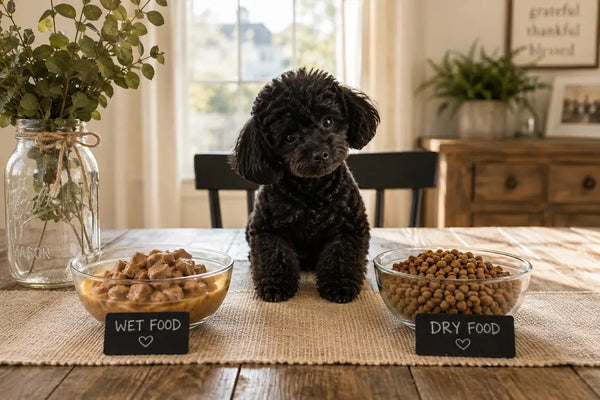
There's no one right answer, but for a teacup poodle, I lowkey prefer mixing a little wet food into a high-quality dry kibble. It gives them extra hydration, makes the food smell better, and softens the crunch for tiny teeth. But both options have their place.
Can teacup poodles eat wet food safely every day
Short answer: Yes, wet food is safe daily if it is complete and balanced; because it has fewer calories per ounce, portion sizes may need to be larger or mixed with dry food.
Teacup poodles can safely eat wet food every day as long as it's nutritionally complete and balanced for their life stage, and you account for the higher water content and lower calorie density. Because wet food has fewer calories per bite, a teacup poodle may need a larger volume to meet their energy needs, which can be tricky with a tiny stomach. Mixing a spoonful into dry food is usually the sweet spot.
Is grain free food good for teacup poodles with sensitivities
Short answer: Only if your vet confirms a grain sensitivity; most teacup poodles do fine with whole grains, and grain-free formulas can swap in legumes that may cause other issues.
Grain-free food is only better for teacup poodles that have a confirmed grain allergy or sensitivity. Most teacup poodles do just fine with whole grains like brown rice and oatmeal, and grain-free formulas sometimes swap in legumes that can cause other issues. If your vet hasn't diagnosed a grain problem, don't go grain-free just because a label says it's trendy. Browse the Paw Vortex dog food and treat collection for both grain-inclusive and grain-free options to talk over with your vet.
Teacup Poodle Puppy Food Essentials
Teacup poodle puppies are the tiniest of the tiny, and their food has to do double duty: fuel growth and keep blood sugar stable. You want a puppy-specific small breed formula with DHA for brain development, ARA for eyes, and real meat protein around 25-30 percent.
Best dog food for teacup poodle puppies under 6 months
Short answer: A puppy-specific small breed formula with DHA/ARA and real meat, such as Blue Buffalo Life Protection Puppy Chicken & Brown Rice, is a strong choice for puppies under 6 months.
For puppies under six months, I recommend starting with Blue Buffalo Life Protection Puppy Dry Food – Chicken & Brown Rice. It has DHA and ARA for brain and eye development, smaller kibble for tiny mouths, and real chicken as the first ingredient. You can soften it with warm water or a little wet food if your pup is struggling to chew. Teacup poodle puppy food is not the place to cheap out, not gonna lie.
How much water should a teacup poodle drink daily
Short answer: About 1 ounce of water per pound of body weight per day, though wet food contributes to hydration; a 3 lb dog needs roughly 3 ounces daily.
A healthy teacup poodle needs about one ounce of water per pound of body weight per day, though wet food can cover some of that. Because they're so small, dehydration can happen faster than you think, especially in warm American summers. A stainless steel pet water fountain can encourage more drinking because moving water catches their eye.
Hypoglycemia Prevention Teacup Poodle Strategies
Hypoglycemia, or low blood sugar, is the scariest thing for teacup poodle owners. It can hit fast—within hours—and it looks like weakness, shakiness, or even seizures. The best prevention is simple: never let more than 6-8 hours go between meals during puppyhood, and always keep a little honey or maple syrup on hand for emergencies.
How to prevent low blood sugar in teacup poodles effectively
Short answer: Feed small, frequent meals every 4–6 hours, never skip meals, add a bedtime snack for puppies under 4 months, and keep honey or maple syrup on hand for emergencies.
Prevent low blood sugar in teacup poodles by feeding small, frequent meals that are high in protein and complex carbs, never skipping meals, and adding a bedtime snack for puppies under 4 months. If you work long hours, a scheduled feeder like the Double Meal Smart Pet Feeder can make sure your pup never goes too long without food. If your dog ever seems wobbly or unresponsive, rub a small amount of honey on their gums and call your vet immediately.
Can teacup poodles eat raw food without health risks
Short answer: Raw food is not recommended for teacup poodles because their tiny size makes them more vulnerable to bacterial contamination and nutritional imbalances.
Raw food is not recommended for teacup poodles because their small size makes them more vulnerable to bacterial contamination and nutritional imbalances. A two-pound dog has almost no margin for error with foodborne pathogens like salmonella or E. coli, and raw diets are hard to balance perfectly at that scale. Unless your vet specifically supervises a raw plan, stick to high-quality commercial food.
Teacup Poodle Weight Management & Calorie Tracking
Even an extra half pound on a 3-pound dog is a lot. That's like a 100-pound person gaining 17 pounds. So yeah, weight management is crucial—but not in a crash-diet kind of way. You want to keep muscle and drop fat slowly.
How to stop teacup poodle from overeating and gaining weight
Short answer: Measure every meal, keep treats under 10% of daily calories, use a slow feeder, and add low-calorie fillers like green beans if your dog acts hungry.
Stop teacup poodle overeating by measuring every meal with a real measuring spoon, limiting treats to 10 percent of daily calories, and using a slow feeder to stretch meals out. A Woof LickMat Slow Feeder Mat is perfect because you can smear wet food or peanut butter on it and it keeps them busy for 15 minutes. If your pup acts starving between meals, try adding a few green beans to their bowl—low calorie and filling.
Teacup poodle weight management without losing muscle mass
Short answer: Keep protein high while trimming fat and calories slightly; avoid drastic portion cuts that could trigger hypoglycemia, and increase gentle activity.
The key to teacup poodle weight management is keeping protein high while trimming fat and calories slightly. Don't cut portions dramatically, because that can trigger hypoglycemia. Instead, swap in a leaner small breed formula and increase gentle activity like short indoor play sessions or slow walks. And always keep the water bowl fresh—hydration can be mistaken for hunger.
Safe Teacup Poodle Treats & Human Foods
Treats are tricky because a single Milk-Bone mini can be 10-15 calories, which is already 10 percent of a teacup poodle's daily intake. So you gotta be strategic. My cat Biscuit turns his nose up at dog treats, but Coco goes nuts for a tiny sliver of boiled chicken.
What treats are safe for teacup poodles in moderation
Short answer: Soft, pea-sized training treats under 3 calories each are safest; avoid hard chews and rawhide, and keep all treats under 10% of daily calories.
Soft, pea-sized training treats under 3 calories each are safest for teacup poodles. Hard chews and bones can crack tiny teeth, and rawhide can be a choking risk. I like Buddy Biscuits Trainers – Soft & Chewy Training Bites because you can break them into even smaller pieces. No matter what treat you choose, keep it under 10 percent of total daily calories.
What human foods are safe for teacup poodles
Short answer: Safe options include plain cooked chicken, carrots, blueberries, green beans, plain pumpkin, and scrambled eggs; avoid grapes, raisins, chocolate, onions, garlic, macadamia nuts, and xylitol.
Safe human foods for teacup poodles include plain cooked chicken, carrots, blueberries, green beans, plain pumpkin, and scrambled eggs. Avoid grapes, raisins, chocolate, onions, garlic, macadamia nuts, and anything with xylitol—those are toxic. When in doubt, don't share it, and check with your vet before making human food a regular thing.
Best Feeder for Teacup Poodle: Slow & Automatic Options
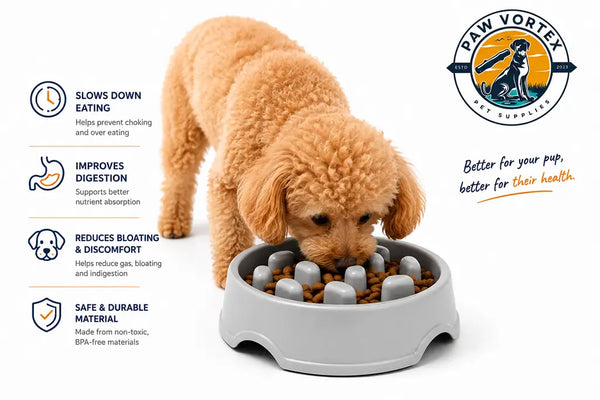
If your teacup poodle inhales their food in 10 seconds, a slow feeder is your best friend. It prevents choking, vomiting, and that post-meal bloat that can be scary in tiny dogs. For busy parents, an automatic feeder with portion control is lowkey a lifesaver.
Recommended from Paw Vortex
For a slow feeder, the Woof LickMat Slow Feeder Mat – BPA-Free, Non-Slip, Dishwasher Safe is a great option because you can smear wet food or peanut butter on it and it keeps them busy for 15 minutes. For automatic, the 6-Meal Smart Pet Feeder – Automatic Timed Feeding Bowl lets you schedule up to six small meals, which is perfect for hypoglycemia prevention. If you want app control and a larger capacity, the Frienhund Automatic Pet Feeder – 7L, App Control & Slow Feeding Mode is worth a look too.
Best slow feeder for teacup poodle that prevents gulping
Short answer: A stainless steel slow feeder with raised ridges or a lick mat works best to slow eating, prevent choking, and reduce bloat risk in tiny dogs.
For a dedicated slow feeder bowl, the Stainless Steel Slow Feeder Dog Bowl has raised ridges that force your dog to eat around them. It's dishwasher safe and heavy enough that your pup won't flip it over. Just make sure the ridge pattern isn't too deep for a tiny tongue.
Best automatic feeder for teacup poodle with portion control
Short answer: A 6-meal automatic timed feeder lets you schedule small, frequent meals and exact portions, which is ideal for hypoglycemia prevention when you're away.
If you travel or work long shifts, an automatic feeder with true portion control is a game changer. The 6-Meal Smart Pet Feeder lets you set exact portions and meal times, so your teacup poodle never goes more than a few hours without food. That alone can prevent a hypoglycemic scare while you're out.
How to Transition Teacup Poodle to New Food
Short answer: Transition over 7 days using a 25/50/75/100 percent mix to avoid diarrhea and food refusal.
Switching a teacup poodle's food too fast can cause diarrhea and food refusal, so a 7-day gradual transition is the safest method.
Step 1: Start with 25% new food
Mix 25 percent new food with 75 percent old food for days 1 and 2. This lets the digestive enzymes adjust slowly.
Step 2: Move to 50% new food
On days 3 and 4, go half old food and half new food. Watch for loose stool or decreased appetite—if you see either, stay at this ratio an extra day or two.
Step 3: Shift to 75% new food
Days 5 and 6 should be 75 percent new food and 25 percent old. By now most dogs are fully used to the new taste and texture.
Step 4: Go 100% new food
Day 7 is all new food. If your pup still has soft stool after a full week, slow the transition down or ask your vet about adding a probiotic.
If at any point your pup gets loose stool or refuses to eat, slow the transition down and call your vet if it persists. Not every food switch is this dramatic, but it's better to take it slow. Teacup poodles have sensitive guts, and the last thing you want is a setback that triggers hypoglycemia.
Teacup Poodle Food Allergies & Grain-Free Considerations
Food allergies in teacup poodles can show up as itchy skin, chronic ear infections, or tummy trouble. But true food allergies are less common than people think; more often it's a sensitivity to a protein like chicken or beef. If you suspect an allergy, don't just swap foods randomly—work with your vet on a proper elimination trial.
Is grain free food good for teacup poodles with allergies
Short answer: Grain-free is not automatically better; a limited ingredient diet with a novel protein is usually more effective, and only switch to grain-free if your vet confirms a grain allergy.
Grain-free food is not automatically better for teacup poodles with allergies; only switch if your vet confirms a grain sensitivity, because many grain-free formulas substitute legumes that can cause other issues. A limited ingredient diet with a novel protein like duck or salmon is usually more helpful than simply removing grains. The Merrick Lil' Plates Grain-Free Wet Food is one option for small dogs, but always get your vet's blessing before going grain-free.
Teacup poodle food allergies: signs and best limited ingredient picks
Short answer: Look for itching, paw licking, ear infections, or loose stools; use a limited ingredient diet with a single novel protein and carb under veterinary guidance.
Look for chronic itching, paw licking, repeated ear infections, or loose stools. If you see these signs, a limited ingredient diet with a single protein and single carb can help you figure out what's triggering the reaction. But don't try to diagnose it alone—your vet can rule out other issues and guide the food trial correctly.

About Paw Vortex
Paw Vortex is your trusted partner in pet care — design-forward, expert-curated solutions for every stage of your pet's journey. Free shipping on orders over $50.
Email Paw Vortex at hello@pawvortex.com · Visit Paw Vortex · Paw Vortex on Facebook · Paw Vortex on Instagram · Paw Vortex on YouTube
What should I feed my teacup poodle?
How much food does a teacup poodle need?
How often should I feed a teacup poodle?
Can teacup poodles eat wet food every day?
How many calories does a teacup poodle need?
What human foods are safe for teacup poodles?
How to prevent low blood sugar in teacup poodles?
Is grain free food good for teacup poodles?
Do teacup poodles need special small breed food?
References
- AKC. (2026). How Long Do Dogs Live?. Retrieved 2026-08-05, from https://www.akc.org/expert-advice/health/how-long-do-dogs-live/
- ASPCA. (2026). Dog Nutrition Tips. Retrieved 2026-08-05, from https://www.aspca.org/pet-care/dog-care/dog-nutrition-tips
- VCA Hospitals. "Nutrition: General Feeding Guidelines for Dogs". Retrieved 2026-04-27. https://vcahospitals.com/know-your-pet/nutrition-general-feeding-guidelines-for-dogs
- VCA Animal Hospitals. (2026). Nutrition: General Feeding Guidelines for Dogs. Retrieved 2026-08-05, from https://vcahospitals.com/know-your-pet/nutrition-general-feeding-guidelines-for-dogs
- AKC. "How to Potty Train Puppies: A Comprehensive Guide for Success". Retrieved 2026-04-27. https://www.akc.org/expert-advice/training/how-to-potty-train-a-puppy/
- ASPCA. (2026). General Dog Care. Retrieved 2026-08-05, from https://www.aspca.org/pet-care/dog-care/general-dog-care


