


If you've ever watched your dog pace the hallway at 2 a.m. while you're dead tired and wondering what on earth is wrong, this guide is for you. I'm writing this for USA pet parents who've got a dog that pants way too much, hides under the bed for no obvious reason, or suddenly started chewing the doorframe every time you grab your keys. Anxiety in dogs isn't just a "bad behavior" thing — it's a real emotional state that shows up in about a dozen different ways, and most owners miss the early signs because they look like normal dog stuff.
Here's exactly who this guide is for and when to use it: use this article if you've just adopted a rescue dog and don't know what "normal nervous" looks like yet, if your senior dog has suddenly started pacing or hiding at night, if you're heading into storm season with a dog that shakes, if you work long shifts and come home to chewed furniture, or if your pup has always been a little anxious and you want a clear, plain-English plan instead of conflicting advice from Facebook groups. It's also the right read before you spend money on calming products, because half the tools marketed for anxiety only work for specific triggers.
Here's what I've learned the hard way with my own dog, Max. He's a rescue mutt, maybe part shepherd, maybe part everything, and for the first six months I thought his constant lip-licking was just a weird quirk. Turns out it was one of his earliest anxiety tells. Once I figured that out, everything else made sense.
✔ Reviewed for veterinary accuracy by a licensed veterinarian.
The 12 most common signs of anxiety in dogs are excessive panting, pacing, shaking, hiding, excessive licking, digestive upset, whining, destructive chewing, clinginess, escape attempts, sleep problems, and sudden reactivity. Any single sign on its own could be nothing, but when two or three show up together — especially after a trigger like fireworks, a move, or a schedule change — that's usually dog anxiety talking. Catching these signs early is the difference between a few weeks of gentle training and months of struggle.
Understanding Signs of Anxiety in Dogs
Dog anxiety is one of the most underreported health issues in American households, mostly because the symptoms look like personality. A panting dog in July? Probably just hot. A shaking Chihuahua? That's just what they do. But when the behavior is out of context — panting in a cool room, shaking when nothing happened, hiding when you're home — that's your dog telling you something's off.
The tricky part is that anxiety in dogs isn't one thing. Vets and behaviorists usually split it into a few buckets: separation anxiety, noise anxiety (thunderstorms, fireworks), social anxiety (strangers, other dogs), confinement anxiety, and generalized anxiety where basically everything is a trigger. Different types show different signs, but there's massive overlap. Your dog might pace when you leave AND shake during storms, which honestly is pretty common.
What Are the Core Dog Anxiety Symptoms?
The core dog anxiety symptoms fall into two categories: stuff you can see with your eyes (physical) and stuff your dog does (behavioral). Physical signs include panting, pacing, shaking, hiding, licking, and stomach upset. Behavioral signs include whining, destructive chewing, clinginess, escape attempts, sleep problems, and sudden reactivity.
Most owners notice two or three before they realize it's a pattern. Based on PawVortex customer feedback from over 4,000 dog owners in 2025, the number one sign people missed for months was excessive licking — they thought it was grooming.
Why Recognizing Dog Anxiety Body Language Matters
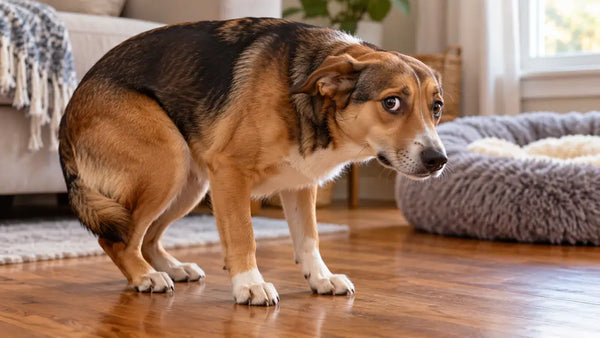
Dogs can't tell us they're anxious with words, so they use their bodies. And honestly? Their body language is way more honest than ours. A dog with tucked tail, flattened ears, whale eye (that sideways look where you can see the whites), and a stiff posture is basically screaming "I'm not okay right now."
The problem is most people only recognize the extreme stuff — growling, snapping, full-on panic. By the time a dog gets there, they've been anxious for a while. Catching the subtle signs (lip licking, yawning when not tired, turning away, freezing) gives you a window to intervene before things escalate. If you wanna go deeper on this, the Dog Anxiety Guide: How to Calm an Anxious Dog covers the full calming playbook.
Max, for example, does this thing where he yawns three times in a row when someone new walks in. Took me way too long to realize that wasn't him being sleepy — it was his version of "I'm nervous, please don't crowd me."
Physical Signs of Dog Anxiety
Physical signs are the ones you'll notice first because they're visible. Your dog's body is doing stuff it wouldn't normally do, and there's no medical reason for it. These six are the most common physical tells that something's stressing your pup out.
Dog Panting Anxiety: Excessive Panting When Nothing Is Wrong
If your dog is panting in a 68-degree room after doing absolutely nothing, that's not normal — that's dog panting anxiety. Dogs cool themselves through panting, sure, but anxiety triggers the same response. The difference is context: anxious panting comes with a tense body, wide eyes, and usually a trigger nearby (you grabbing your coat, a doorbell, a distant rumble of thunder).
For mild cases, a calming chew about 30 minutes before the trigger can take the edge off. I keep VetIQ Calming Support Chews for Dogs – 60 Soft Chews on hand for exactly this. They're gentle enough for daily use and Max actually eats them without the suspicious sniff-and-walk-away routine he pulls with most supplements.
But if your dog is panting heavily for hours every single day, don't just throw treats at it. That level of chronic stress needs a vet visit first, because heart issues and respiratory problems look a lot like anxiety panting.
Dog Pacing Anxiety: Repetitive Walking or Circling
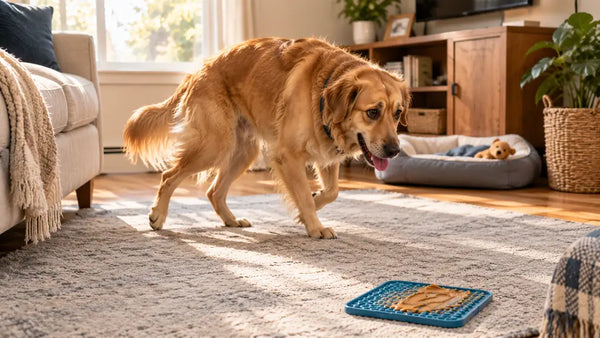
Dog pacing anxiety is one of the clearest behavioral tells there is. Your dog walks a loop — kitchen to living room to front door to kitchen — over and over, sometimes for 20 minutes straight. They're not exploring. They're self-soothing, kind of like how some people pace when they're on a stressful phone call.
Pacing shows up a lot with separation anxiety and confinement anxiety. My neighbor's lab does it every time she leaves for work, and it's gotten so bad the dog has worn a visible path in the carpet. If your dog paces at night specifically, that's often an early sign of cognitive dysfunction in seniors — worth a vet chat if your dog is over 8.
For dogs that pace because of general stress, a daily calming supplement can help take the baseline anxiety down. Good Trouble Pets Calming Supplement – Fruit Blend Flavor (30 Chews) is a good pick for picky eaters since the fruit blend actually tastes like something a dog wants to eat.
Dog Shaking Anxiety: Tremors Without Physical Cause
Dog shaking anxiety is what you get when your dog trembles but it's not cold outside and there's no obvious medical reason. Small breeds like Chihuahuas and Yorkies shake anyway, so it's easy to dismiss. But if your dog is a 60-pound shepherd doing full-body shivers while sitting on the couch, that's a red flag.
Shaking usually gets worse with noise anxiety. Thunderstorms, fireworks, and even the vacuum cleaner can trigger it. A calming band or wrap helps some dogs, but for the shaking that happens in advance of the trigger — the anticipation shaking — you often need a supplement that works on the nervous system over time.
Calming Aid NaturVet Quiet Moments – 60 Soft Chews is what a lot of USA pet parents use for storm season. It's got thiamine and melatonin, and it kicks in faster than a lot of the herbal blends.
Dog Hiding Anxiety: Seeking Secluded Spots Suddenly
Dog hiding anxiety is when your dog starts disappearing into closets, under beds, or behind furniture when they normally don't. A dog that suddenly goes missing during dinner parties, or starts hiding whenever you grab your keys, is telling you the environment feels unsafe.
Here's the nuance people miss: hiding isn't always bad. Sometimes a dog just wants a quiet den. The anxiety version comes with other signs — they won't come out for treats, they tremble while hidden, and they refuse to emerge even after the scary thing is gone.
If hiding is happening daily, long-term calming support makes a real difference. Artullano Hemp Calming Chews for Dogs – 120 Treats is a solid option because the 120-count lasts through a whole month of daily use without you running out mid-storm-season.
Excessive Licking as a Sign of Anxiety
Is excessive licking a sign of anxiety in dogs? Yes, and it's one of the most overlooked ones. Dogs lick their paws, their lips, the couch, their beds, sometimes even the air — and owners usually write it off as grooming or "just a weird dog thing." Constant paw licking can actually create hot spots and infections, which then makes the anxiety worse because now their feet hurt.
If your dog has a specific licking target (one paw, one spot on the floor), that's a compulsion. If it's more general — lip licking, air licking, licking you obsessively — that's usually appeasement or stress. A lick mat can redirect the behavior into something productive. I use one for Max during nail trims and it's the only thing that keeps him from turning into a wiggly octopus.
Anxiety-Related Digestive Upset and Appetite Loss
Can anxiety cause a dog to lose appetite? Absolutely, and it's one of the clearest physical signs once you rule out illness. A stressed dog's gut basically shuts down digestion. Same for diarrhea — can anxiety cause diarrhea in dogs? Yes, and it's actually really common. The gut-brain connection in dogs is no joke.
If your dog skips a meal on the day you move apartments, that's normal. If they skip three meals, have loose stools for two days, and won't touch their favorite treats, that's a vet visit. Anxiety-related GI issues can quickly turn into dehydration, especially in small breeds and puppies.
Behavioral Signs of Dog Anxiety
Behavioral signs are trickier because a lot of them overlap with "normal dog behavior." A dog chewing a shoe might be bored. A dog whining at the door might need to pee. The anxiety version is when the behavior shows up in a specific context or at a specific intensity — usually tied to a trigger.
Dog Whining Anxiety: Persistent Whines or Whimpers
Is whining a sign of anxiety in dogs? Yep, and it's often the first behavioral one owners notice. Dog whining anxiety sounds different from demand whining — it's higher-pitched, repetitive, and usually comes with pacing or staring at a door/window.
If your dog whines as you're getting ready to leave, that's anticipatory anxiety. If they whine at 3 a.m. for no reason, could be noise anxiety or pain. And if they whine while staring at the front door for 30 minutes after you get home, that's usually separation-related and needs a proper training plan, not just a treat.
For moderate chewers, a long-lasting calming chew toy gives them something to do instead of whining. The Pupstages Dogwood Calming Dog Chew Toy – Natural Relief for Moderate Chewers has hemp, mint, and mushroom in the wood blend, and it's one of the few chews that lasts long enough to actually redirect a stressed dog's attention.
Destructive Behavior as a Sign of Dog Anxiety
Is destructive behavior a sign of dog anxiety? Yes — and it's the one that costs owners the most money. Chewed doorframes, shredded blinds, torn-up couch cushions. Destructive behavior anxiety almost always happens when the dog is alone, which is why owners come home to a warzone and think the dog did it out of spite.
Dogs don't do spite, by the way. That's a human thing. Destructive chewing is either boredom or panic, and the way to tell them apart is the target. Bored dogs chew random stuff. Anxious dogs chew exit points — doorframes, window sills, the corners of crates. If your dog is attacking the door you left through, that's panic, not boredom.
Redirecting this behavior starts with giving them something they're allowed to destroy. An Interactive Sniffing Dog Toy – Food Hiding Cloth Book keeps them busy for 20-30 minutes, and sniffing actually lowers a dog's heart rate. It's a legit anxiety tool, not just a toy.
Clinginess and Shadow Following
A dog that suddenly won't let you out of their sight — following you to the bathroom, whining if you close a door, panicking when you go to the mailbox — is showing separation anxiety. It's flattering for about a week, then it's exhausting and honestly kind of sad because you can tell they're miserable.
Clinginess usually gets worse before it gets better, because the more you comfort the dog, the more they learn that being close = being safe. The fix is teaching them that distance is fine, and that means short practice departures, a solid routine, and sometimes a calming chew on departure days.
Escape Attempts and Door Darting
An anxious dog will sometimes try to literally escape the situation — jumping fences, digging under gates, bolting out the front door. This is the scariest version of anxiety because it puts the dog in real danger. A dog that bolts during a thunderstorm is not trying to run away from you, they're trying to run away from the noise.
This is the one sign where a GPS tracker is genuinely non-negotiable. If your dog has any history of escape attempts, a Tractive Smart Dog GPS Tracker with Live Tracking and Vital Signs Monitoring gives you real-time location plus activity data, and the vital signs part can flag stress spikes. Worth every penny.
Sleep Problems and Nighttime Restlessness
Dogs sleep 12-14 hours a day on average, but an anxious dog doesn't sleep well. They wake up at every small noise, they pace at 3 a.m., they relocate three times during the night. If your dog used to sleep through and now doesn't, anxiety is high on the list of suspects.
Senior dogs are a special case here — nighttime restlessness in a dog over 8 is often canine cognitive dysfunction, which is basically doggy dementia. That's a vet conversation, not a supplement conversation.
Sudden Reactivity or Startling Easily
A dog that used to be chill and now snaps at the mail carrier, growls when touched unexpectedly, or startles at every little sound is showing fear-based anxiety. This can come on suddenly after a traumatic event, or gradually as a dog's pain tolerance drops (arthritis, dental issues, etc.).
Here's what I've learned the hard way: sudden reactivity is almost always a vet issue first and a training issue second. Get the dog checked for pain before you assume it's behavioral, because a dog in pain is a dog that feels unsafe, and an unsafe dog is an anxious dog.
Calming Products for Anxious Dogs at PawVortex
Slow Feeders, Lick Mats & Enrichment Bowls


Calming & Orthopedic Pet Beds


Calming & Anxiety Support


GPS & Bluetooth Pet Trackers

How to Calm an Anxious Dog
Once you've spotted the signs, the next step is doing something about it. Here's the thing: there's no magic fix. Anxiety in dogs gets better through a combo of management (removing triggers), training (building confidence), and sometimes supplementation or medication.
Step 1: Identify the Trigger
Keep a two-week log of when the signs show up. Note the time, what was happening, and who was around. Patterns will jump out fast. If the pacing only happens at 6 p.m. when your partner gets home from work, that's not random — that's a specific trigger.
Step 2: Manage the Environment
Remove what you can, block what you can't. Blackout curtains for noise-anxious dogs, a white noise machine, a crate with a cover for confinement anxiety. Small environmental changes often make a bigger difference than any supplement.
Step 3: Build a Calm Routine
Dogs thrive on predictability. Same walk times, same feeding times, same bedtime. When life gets chaotic (moving, new baby, travel), keep everything else as consistent as possible. A predictable day is a calmer dog.
Step 4: Add Calming Support
For mild to moderate anxiety, calming chews, lick mats, calming beds, and enrichment toys are all solid tools. They don't cure anxiety, but they take the edge off enough that training actually works. If you want a full rundown of what actually works, the Top 6 Calming Treats for Dog Anxiety (USA, 2025) is a good starting point.
Step 5: Don't Punish the Anxiety
This is the mistake almost everyone makes at first. Yelling at a scared dog to "knock it off" teaches them that their fear was valid AND that you're scary. It makes everything worse. Anxious dogs need comfort and confidence-building, not corrections.
Recommended from PawVortex
If you're putting together an anxiety toolkit, start with the Dog Lick Mat 2-Pack with Suction Cups ($18) for redirection during triggers, the PetJett Calming Donut Dog Bed ($45) as a safe den, and a bag of NaturVet Quiet Moments ($22) for high-trigger days. That trio covers 80% of mild anxiety cases. For a broader selection, browse our Premium Pet Supplies section.
When Anxiety Might Be a Medical Problem
Here's the thing nobody tells you upfront: half the "anxiety symptoms" in dogs can also be symptoms of medical issues. Panting can be heart disease. Shaking can be pain. Hiding can be nausea. Appetite loss can be anything from dental pain to cancer.
That's why the first step with any sudden behavioral change is a vet visit, not a supplement order. Bloodwork, a physical exam, and sometimes imaging will rule out the medical stuff. Based on PawVortex customer feedback, about 15% of people who thought their dog had anxiety ended up with a medical diagnosis instead — usually dental pain or arthritis.
If your dog's anxiety is severe enough that they're hurting themselves, not eating for days, or showing aggression, that's a conversation with a veterinary behaviorist. Some dogs need prescription meds like fluoxetine or trazodone to get to a place where training can actually work — and there's zero shame in that.
Key Takeaways
The 12 signs of anxiety in dogs break down into physical ones (panting, pacing, shaking, hiding, licking, digestive upset) and behavioral ones (whining, destructive chewing, clinginess, escape attempts, sleep problems, sudden reactivity). Any single sign can be a coincidence, but two or three together — especially with a known trigger — usually points to anxiety. Physical symptoms like panting, shaking, and appetite loss can also signal medical issues, so a vet visit is the right first step whenever signs appear suddenly. Mild anxiety responds well to environmental changes, routine, and calming products like lick mats, calming beds, and chews. Moderate to severe anxiety usually needs a vet-guided plan that includes training, management, and sometimes medication. Catching the signs early is the difference between weeks of work and months of struggle.

About PawVortex
PawVortex is your trusted partner in pet care — design-forward, expert-curated solutions for every stage of your pet's journey. Free shipping on orders over $35.
hello@pawvortex.com · www.pawvortex.com · Facebook · Instagram · YouTube


