


Okay so here's the thing. You're scrolling through your phone at lunch, your dog is losing his mind because the neighbor's landscaper just fired up a leaf blower, and you're wondering if throwing on some Spotify piano playlist is actually gonna do anything. I've been there. My dog Max used to hide under the bed every single time a thunderstorm rolled through our neighborhood in Ohio. I tried everything — treats, calming chews, that thunder shirt that looks like a tiny weighted vest. And yeah, I tried music. Lots of it.
If you're an American dog parent dealing with a pup who panics during storms, freaks out when you leave for work, or just can't seem to settle down at night, this guide is for you. We're gonna get into what the actual research says about calming music for dogs, what types of music seem to work best, and how to use it alongside other tools you might already have in your anti-anxiety arsenal. No fluff. Just stuff that actually helps.
✔ Reviewed for veterinary accuracy by a licensed veterinarian.
Calming music for dogs can genuinely help reduce anxiety in many situations, especially for separation anxiety, thunderstorms, and settling at night. Research shows that classical music at a low volume tends to have the most consistent calming effect, though results vary by dog. The key is using music as one part of a broader anxiety-management plan, not as a standalone fix.
Understanding Dog Anxiety and Why Music Helps
Dog anxiety is a real, measurable physiological response — not just your dog being dramatic. When a dog gets scared, their body releases cortisol, their heart rate spikes, and their whole system goes into fight-or-flight mode. It's the same stress response humans have, and it can be triggered by tons of stuff: loud noises, being left alone, changes in routine, even just a weird smell in the house.
Anxiety affects a huge chunk of the American dog population. According to the ASPCA, common dog behavior issues like separation distress, excessive barking, and destructive chewing are among the top reasons pet parents seek help. It's not a niche problem. It's an everyday struggle for millions of households.
And here's where music comes in. Sound is one of the easiest environmental levers you can pull to change your dog's emotional state. You can't always control the thunder or the delivery truck backing up outside. But you can control what's playing in your living room. That's the whole premise behind calming music for dogs — you're using auditory input to nudge your dog's nervous system toward "chill" instead of "code red."
The CDC's Healthy Pets program notes that a dog's environment and daily routine play a major role in their overall health and behavior. That includes the sounds they're exposed to. A chaotic, noisy home can keep a dog's stress hormones elevated. A calm one can help them settle.
What Is Dog Anxiety Music?
Dog anxiety music is any audio — usually instrumental — played specifically to reduce stress and promote relaxation in dogs. It's not a genre in the traditional sense. It's more of a category defined by its purpose. You'll find playlists labeled "dog relaxation music," albums marketed as "music for dogs with anxiety," and even tracks designed around the tempo of a dog's resting heart rate.
Most of what's sold as dog-specific music leans on classical arrangements, soft piano, or ambient nature sounds. The idea is to keep things predictable, low-energy, and free from sudden volume shifts that could startle your pup. Some brands go further and claim their tracks are psychoacoustically engineered for canine ears. The science on that specific claim is still thin, but the general concept of using sound to shape behavior? That part has real support.
My dog Max couldn't care less about the branding. He just knows when the music changes from whatever my wife is playing to the quiet piano station, the vibe in the house shifts. And honestly? I think I relax a little too, which probably helps him more than the actual notes.
How Music Reduces Stress in Dogs
Music seems to reduce stress in dogs through a few overlapping mechanisms. The most well-supported one is pretty straightforward: calm, predictable sound masks the unpredictable noises that trigger anxiety in the first place. If your dog is hearing a steady stream of soft piano, the bang of a thunderclap is less jarring by comparison.
There's also a physiological angle. Some research suggests that certain tempos and frequencies can influence heart rate and breathing patterns, nudging the body toward a parasympathetic (rest-and-digest) state. It's the same principle behind why humans find slow music soothing. Dogs share enough of our auditory processing wiring that some of those effects seem to carry over.
According to a review published in the journal Animals, exposure to classical music appears to have a calming influence on dogs in stressful environments, with no additional benefit observed from music specifically designed for dogs. That's a big deal because it means you probably don't need to buy some expensive "canine-engineered" album. Regular classical music might do the trick just fine.
A separate randomized controlled trial published in the Journal of the American Veterinary Medical Association found that playing classical music at a low volume during veterinary visits improved owner satisfaction and was described as a simple, cost-effective way to improve the experience. The study didn't show dramatic changes in dog anxiety scores, which tells us something important: music helps, but it's not a magic wand. Especially in high-stress situations.
Here's the quotable takeaway: music is a low-risk, low-cost tool that can meaningfully improve your dog's environment, but it works best as part of a layered approach.
What Is the Best Calming Music for Dogs?
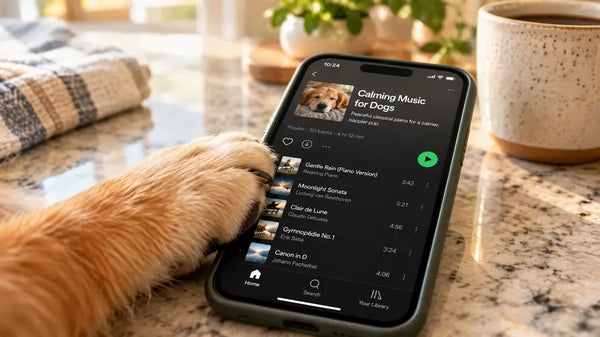
The short answer? Classical music, played at low volume, is the most consistently effective option based on current research. But "classical" is a broad category, and not every symphony is gonna work for every dog. Some pups respond better to solo piano. Others chill out to soft jazz or ambient nature sounds. The best music for your dog is the music that actually calms your dog, and you'll only figure that out by experimenting.
Here's a comparison of the main types you'll see recommended for dog anxiety, along with what the evidence says and what I've seen work in real life.
My personal experience lines up with what the research suggests. Max responds best to slow piano — the kind of stuff you'd hear in a spa waiting room. He completely ignores those "psychoacoustic canine" tracks I tried once. Waste of ten bucks, honestly. But a plain old Chopin nocturne? He's out cold on his bed within twenty minutes.
Does Classical Music Calm Anxious Dogs?
Yes, classical music does appear to calm anxious dogs in many situations, according to the accumulated research. The Animals review I mentioned earlier looked at nine experimental studies on music and dogs and concluded that classical music has a generally calming influence. That's about as clear a verdict as you're gonna get from a body of research that's still growing.
But here's the nuance that the headline version misses. The same review found no extra benefit from music specifically engineered for dogs versus regular classical. So if you've been eyeing some $30 "canine sound therapy" album, you can probably save your money and just queue up some Debussy instead.
The other thing to keep in mind is that "calming" is relative. A dog in a full-blown panic during a thunderstorm might not respond to music at all in that moment. The stressor is too intense. But for day-to-day anxiety — the kind that shows up as pacing, whining, or destructive chewing when you leave — classical music has a pretty solid track record.
What Frequency and Volume Is Best?
There isn't a single "correct" frequency for calming music, but lower, softer frequencies tend to be more soothing than high-pitched or sharp sounds. Think cello instead of piccolo. Think soft piano instead of electric guitar. The goal is to avoid anything that grabs attention in an alerting way.
Volume matters just as much as frequency. The JAVMA trial specifically noted that playing classical music at a low volume was effective and cost-efficient. Loud music — even if it's technically "calm" music — can backfire because it adds to the sensory load instead of reducing it. A good rule of thumb is to keep it at a level where you can still have a normal conversation over it. If you have to raise your voice, it's too loud for your dog.
If you're looking for a starting point, PawVortex carries a range of calming treats for dogs that pair well with a music-based routine. You can check out our 2026 calming treats guide for specific product picks.
Music for Dogs with Separation Anxiety
Separation anxiety is where calming music for dogs really earns its keep. Unlike thunderstorms, which are intense but brief, separation anxiety is a daily, recurring stressor for a lot of dogs. You leave for work, your dog spends eight hours in a state of low-grade panic, and you come home to chewed furniture and a neighbor who's been listening to barking all day.
Music can't teach your dog that being alone is safe — that takes counter-conditioning and gradual desensitization. But it can make the alone-time environment less triggering. The ASPCA notes that providing environmental enrichment and a predictable routine helps reduce many common behavioral problems, including anxiety-related ones. That's a vet-backed, low-effort intervention you can start today.
Here's what I've learned the hard way with Max: leaving the music on all day isn't the move. He gets bored with it, and honestly, I think the constant sound starts to feel like noise pollution. What works better is a shorter playlist — maybe 30 to 45 minutes — timed to start right when I leave. It gives him something to focus on during the initial panic window, and by the time it ends, he's usually settled into a nap.
You can also pair music with a food puzzle or a lick mat to extend the calm. Check out these dog lick mats with suction cups — they're a great way to keep your dog's brain busy while the music does its thing.
What Music Is Best for Dogs Left Home Alone?
Classical music, soft piano, or ambient nature sounds are the best options for dogs left home alone, based on both research and practical experience. The goal is to create a consistent, predictable sound environment that doesn't demand attention but also doesn't leave your dog in silence — which can amplify every little creak and outside noise.
What you want to avoid is anything with sudden changes in volume or tempo. No talk radio with people shouting. No heavy metal, obviously. Even some "relaxing" playlists have tracks that build to a crescendo, which can startle a nervous dog. Test a playlist at home before you leave your dog with it.
One more thing: consistency matters. If you play the same playlist every time you leave, your dog starts to associate that sound with "alone time is starting, but it's okay." It becomes a cue. That's way more powerful than just having random music on.
Does Music Help Dogs During Thunderstorms and Fireworks?

Music can help dogs during thunderstorms and fireworks, but only as a masking tool — it won't eliminate the fear. The ASPCA's guidance for pets scared of loud noises includes creating a safe, quiet space and using background sound to soften the impact. That's a practical, layered approach: you're reducing the visual triggers and the auditory ones at the same time.
The tricky part is that thunderstorms and fireworks are high-intensity stressors. The JAVMA study I cited earlier actually found that in a really stressful situation (a vet visit), music didn't significantly change most anxiety measures. That's a clue that for the most intense triggers, music alone probably isn't enough. You're gonna need to combine it with other stuff — a safe space, maybe a calming supplement, possibly medication if your vet recommends it.
For Max, the winning combo during storms was a fan on high, the bathroom door open (he likes small spaces), and a quiet piano playlist. The fan created a constant white noise base, and the music filled in the gaps. He still wasn't thrilled, but he stopped the shaking and panting. That's a win in my book.
If your dog has severe storm phobia, please talk to your vet. There are anti-anxiety medications specifically for this, and there's no shame in using them. Music is a tool, not a cure.
What Sounds Calm Dogs During Storms?
Sounds that mask the triggering noise without adding new stress are the most effective during storms. That usually means steady, low-frequency sounds — classical music at low volume, nature sounds like rain or ocean waves (ironically, the sound of rain can be calming even during a real storm), white noise, or the hum of a fan or air conditioner.
The goal is to make the thunder less sudden and less loud relative to everything else your dog is hearing. If the storm is the only thing they can hear, every crack of thunder hits like a gunshot. If there's a steady blanket of soothing sound, the thunder becomes one of many things in the auditory landscape instead of the only thing.
Music for Anxious Dogs at Night and Sleep
Yes, calming music can help a dog sleep, especially if their nighttime anxiety is tied to being alone in the dark or to noises they can't identify. A lot of dogs who pace or whine at night aren't actually tired — they're alert. Their brain is scanning for threats. Soft background music gives that scanning brain something neutral to latch onto.
The best music for anxious dogs at night tends to be the slowest, least eventful stuff you can find. Ambient piano. Very slow string arrangements. Nature soundscapes without any sudden bird chirps or animal calls. You want audio that's almost boring. That's the point.
A word of caution: don't leave music on all night if your dog is a light sleeper. Dogs need deep sleep just like we do, and constant sound can interfere with that. A timer that turns the music off after an hour or two is a good compromise. Max sleeps through anything after about 10 p.m., so I just let his playlist run until the smart speaker shuts it off at midnight.
If your dog struggles with nighttime anxiety, a calming bed can make a huge difference alongside the music. PawVortex has some great options in our Labrador anxiety guide that apply to most breeds, honestly.
Does White Noise Help Dogs with Anxiety?
White noise can help dogs with anxiety, particularly if the anxiety is triggered by environmental sounds they can't predict. It's not music, but it serves a similar function: it fills the auditory space with something constant and unthreatening, which makes sudden noises stand out less.
That said, white noise isn't a universal fix. Some dogs find the hiss of white noise irritating rather than soothing. Others do great with it. It really depends on the individual dog. If you live in an apartment with thin walls and your dog reacts to every hallway noise, a white noise machine or a fan can be a game-changer. If your dog's anxiety is more about being alone, music is probably the better bet because it provides a more engaging sensory experience.
The Ohio State Indoor Pet Initiative emphasizes that indoor dogs need environmental management to thrive — and that includes managing sound, light, and the overall sensory load in the home. White noise is one tool in that toolkit, but it's not the only one.
How to Use Calming Music with Other Anxiety Treatments
The single biggest mistake I see dog parents make is treating music like a standalone solution. It's not. It's one layer in a multi-layer approach. The dogs who get the most benefit from calming music are the ones whose owners also address the other stuff: the environment, the routine, the physical and mental exercise, and in some cases, supplements or medication.
Here's how I'd think about stacking your tools.
The order matters less than the consistency. Pick two or three layers that fit your life and actually stick with them. A half-hearted attempt at five different interventions won't do as much as a solid routine built around two.
One thing I'd add: if your dog's anxiety is severe enough that they're hurting themselves or destroying your home, please see a vet behaviorist. Music is great, but it's not a substitute for professional help. The CDC's Healthy Pets program also stresses the importance of regular veterinary care for catching and managing health issues that can contribute to behavioral changes. And there's no shame in going that route.
Recommended from PawVortex
If you're looking to build out your dog's calming toolkit, here are a few PawVortex picks that pair well with a music-based routine. The VetIQ Calming Support Chews are a solid everyday option for mild anxiety, and the NaturVet Quiet Moments chews are a go-to for vet visits and travel. For a non-ingestible option, the Happy Hoodie calming band is great for grooming and noise sensitivity. And honestly, a good calming donut bed does more for nighttime anxiety than any playlist I've tried.
Calming Products for Anxious Dogs
Calming & Anxiety Support


Calming & Orthopedic Pet Beds


Shampoos & Drying Towels

Dental Chews & Dental Health

Dog Food — Dry, Wet & Fresh

Slow Feeders, Lick Mats & Enrichment Bowls

Frequently Asked Questions
Does calming music actually work for dogs?
What is the best calming music for dogs?
What music helps dogs with anxiety?
Can calming music help dogs with separation anxiety?
Does music help dogs during thunderstorms?
Should I leave calming music on for my dog when I leave?
Can calming music help a dog sleep?
Does white noise help dogs with anxiety?
Can I use calming music with other dog anxiety treatments?
Key Takeaways
Classical music played at low volume is the most consistently effective type of calming music for dogs, according to multiple studies and reviews. Music works best as one layer in a broader anxiety-management plan that includes environment, routine, supplements, and sometimes veterinary care. A shorter playlist timed to start when you leave is usually more effective for separation anxiety than leaving music on all day. For thunderstorms and fireworks, music helps by masking triggering sounds but may not be enough on its own for severe phobias. Always consult your vet if your dog's anxiety is severe or causing self-injury or property destruction.

About PawVortex
PawVortex is your trusted partner in pet care — design-forward, expert-curated solutions for every stage of your pet's journey. Free shipping on orders over $35.
hello@pawvortex.com · www.pawvortex.com · Facebook · Instagram · YouTube


